Back in 2009, Bitcoin was just an experiment in digital money. Created by the pseudonymous Satoshi Nakamoto, it aimed to be a decentralised currency free from traditional banks. But here’s the thing: nobody really knew about it, and even fewer cared. Bitcoin had no real-world value and only a handful of enthusiasts.
That’s where Bitcoin faucets came in. These platforms gave people free Bitcoin, making it easier to explore what the fuss was about without spending a dime. They were simple, effective, and revolutionary for a technology still trying to find its feet.
Gavin Andresen: The Spark Behind Bitcoin Faucets
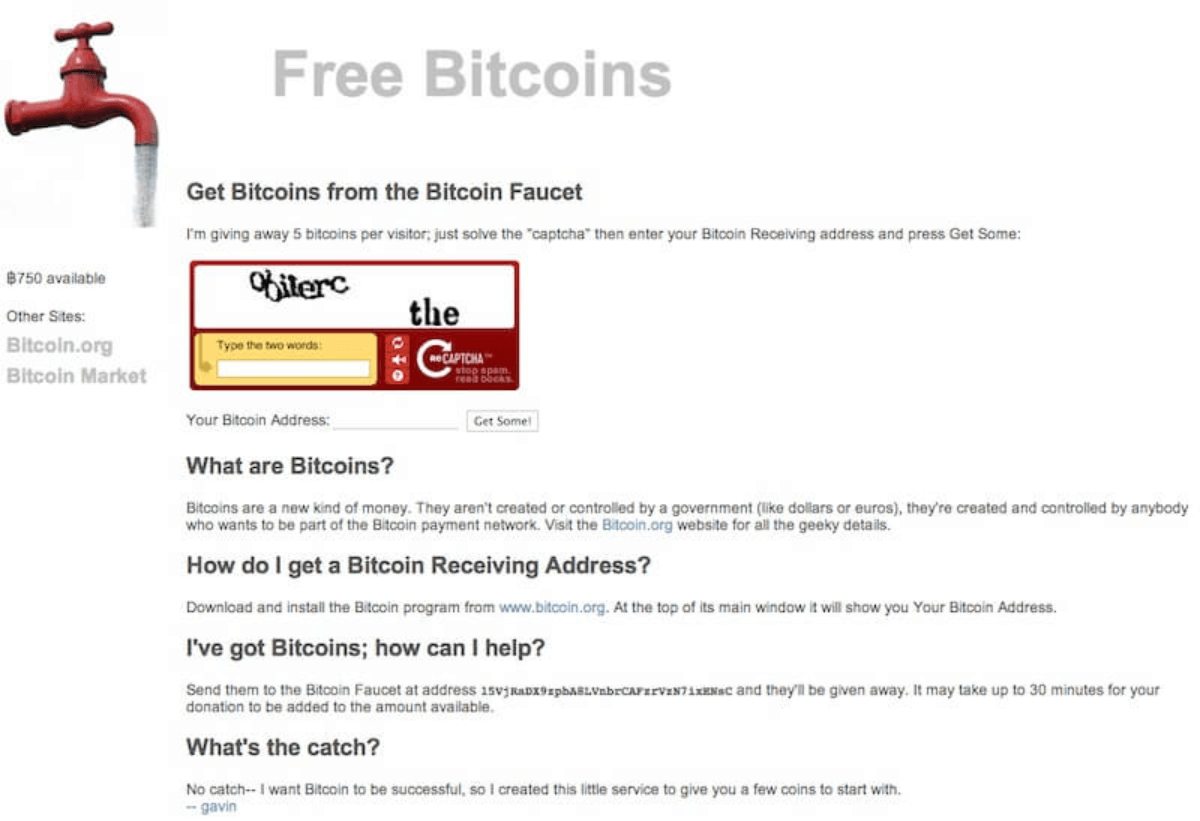
In 2010, Gavin Andresen, one of Bitcoin’s early developers and a close collaborator of Nakamoto, came up with an idea that would change the game. He launched the first Bitcoin faucet, a website designed to distribute free Bitcoin. His faucet gave away 5 BTC per visitor—a staggering sum today but worth just pennies back then.
Andresen’s mission was clear:
- Raise awareness about Bitcoin.
- Encourage everyday users to experiment with it.
- Distribute Bitcoin widely to promote decentralisation.
Gavin didn’t just contribute to the software’s development; he made Bitcoin approachable, turning a nerdy idea into something tangible for anyone willing to give it a shot.
Key Things to Know About Bitcoin Faucets:
- What They Are: Websites or apps that reward users with tiny amounts of Bitcoin for completing tasks or simply visiting.
- Why They Matter: Introduced Bitcoin to thousands, laying the groundwork for broader adoption.
- The First Bitcoin Faucet: Distributed a total of 19,715 BTC between 2010 and 2012.
- Long-Term Impact: Faucets didn’t just spread Bitcoin—they helped create an early, enthusiastic community.
Up next, we’ll explore how this simple faucet became a catalyst for Bitcoin’s adoption and how it changed the crypto landscape forever.
The Genesis of Bitcoin Faucets
Concept and Purpose
What is a Bitcoin Faucet?
A Bitcoin faucet is a platform designed to distribute small amounts of Bitcoin (BTC) for free, often in exchange for completing simple tasks or solving captchas. Think of it as a “crypto drip”—a slow, steady way for people to get their first taste of Bitcoin.
The main idea?
- Introduce Bitcoin to the masses: Faucets removed financial risk, making Bitcoin approachable for beginners.
- Build awareness: At a time when Bitcoin was unknown and often misunderstood, faucets served as a gateway to understanding crypto.
- Educate newcomers: They encouraged hands-on learning by letting users receive and transact Bitcoin in real-time.
Creation of the First Bitcoin Faucet
In June 2010, Bitcoin developer Gavin Andresen launched the first Bitcoin faucet on a website called freebitcoins.appspot.com. The faucet was designed to distribute 5 BTC per user, no strings attached. The only requirement? Solve a simple captcha to verify you were human.
Here’s why this was groundbreaking:
- Bitcoin was practically worthless at the time: The value of 1 BTC was just a few cents. Giving away 5 BTC might seem absurd now, but back then, it was an effective way to encourage adoption.
- Simplified the Bitcoin experience: Users could claim free Bitcoin without setting up complex mining rigs or making purchases.
Key Numbers:
- Launch Date: June 2010.
- BTC Distributed per Claim: 5 BTC (now worth over $180,000 per claim as of late 2024).
- Total BTC Distributed: Approximately 19,715 BTC, valued at pennies during the faucet’s operation but a fortune in today’s market.
Gavin Andresen’s faucet wasn’t just a giveaway; it was a leap forward in making Bitcoin accessible. Its simplicity and generosity laid the foundation for Bitcoin’s initial distribution and brought thousands of new users into the crypto fold.
Impact on Bitcoin Adoption
Raising Awareness
When Bitcoin first emerged, it was a mystery wrapped in code. People didn’t understand it, and most were skeptical about a “digital currency” that wasn’t backed by any government or institution. Enter Bitcoin faucets, like Gavin Andresen’s creation. These platforms provided a simple, risk-free way to get Bitcoin into people’s hands, sparking curiosity and opening doors to exploration.
- Faucets demystified Bitcoin by showing users how it worked in practice.
- They bridged the gap between complex crypto concepts and everyday people by providing a tangible experience with Bitcoin.
Instead of just reading about it, users could now use it. This hands-on introduction played a significant role in normalising Bitcoin for the general public.
Encouraging Experimentation
One of the biggest hurdles to adopting new technology is the fear of the unknown. Faucets eliminated that fear:
- No financial risk: Users didn’t need to spend their own money to acquire Bitcoin.
- Test-drive transactions: People could experiment with sending and receiving Bitcoin without consequences.
By making Bitcoin approachable, faucets empowered users to explore wallets, test transactions, and understand the potential of blockchain technology. It wasn’t just theory—it was practice.
Distribution of Bitcoin
Decentralisation is at the heart of Bitcoin’s philosophy. Faucets actively supported this by distributing Bitcoin widely and freely.
Here’s why this mattered:
- Spreading Bitcoin’s reach: Instead of a few early adopters hoarding all the coins, faucets gave thousands of people a chance to hold Bitcoin.
- Building a decentralised network: More users meant more nodes, wallets, and transactions, strengthening Bitcoin’s ecosystem.
This initial distribution helped lay the groundwork for Bitcoin’s later growth. What started as a niche experiment gained momentum as more people joined the network, creating a snowball effect of adoption and interest.
Up next, we’ll dive into the evolution of Bitcoin faucets, exploring how they adapted to the changing crypto landscape and expanded their role in promoting cryptocurrencies.
Evolution of Bitcoin Faucets
Surge in Popularity
Bitcoin faucets started small but gained massive traction as Bitcoin’s popularity exploded—particularly during its bull run in 2017.
- 2017 Boom: As Bitcoin’s price skyrocketed, so did global interest in owning even a fraction of the digital currency. Faucets became the go-to method for newcomers to get their first taste of Bitcoin.
- Expansion of Offerings: To stay relevant, faucets began offering various ways to earn rewards, such as:
- Watching ads.
- Completing captchas.
- Participating in quizzes and simple microtasks.
These innovations turned faucets into more than just giveaways; they became entry-level crypto education platforms for millions.
Introduction of Micro Wallets
With the increasing use of faucets, a new problem arose: managing small Bitcoin payouts. The solution? Micro wallets.
- What Are Micro Wallets?
- Specialised wallets designed to consolidate and manage tiny cryptocurrency transactions from multiple faucets.
- Why They Were Needed:
- Traditional wallets charged high fees for small transactions.
- Micro wallets let users collect earnings until they hit a withdrawal threshold, making faucet payouts more practical.
Micro wallets streamlined the faucet ecosystem, enabling users to maximise their earnings and making faucets more user-friendly.
Modern Faucets
Today’s Bitcoin faucets look nothing like the original 2010 version. They’ve evolved into sophisticated platforms offering more than just free Bitcoin.
- Referral Programs:
- Faucets now incentivise users to bring in new participants by sharing referral links, creating a viral growth model.
- Microtasks and Gamification:
- Tasks like watching videos, taking surveys, or playing games are now common ways to earn small amounts of Bitcoin.
- Gamification keeps users engaged, turning earning Bitcoin into an interactive experience.
- Marketing Tools for New Projects:
- Cryptocurrency projects use faucets to promote their tokens or coins. By giving users free tokens, they build awareness and create an engaged community around their blockchain initiative.
Modern faucets aren’t just about handing out Bitcoin—they’ve become marketing engines, engagement tools, and educational hubs for the ever-growing cryptocurrency ecosystem.
Next, we’ll explore the challenges faucets face today and their lasting legacy in the cryptocurrency world.
Challenges and Decline
Sustainability Issues
Bitcoin faucets started as generous tools for spreading awareness and adoption, but as Bitcoin’s value soared, their operations faced mounting challenges:
- Skyrocketing Bitcoin Value:
- In 2010, 5 BTC was worth mere pennies. By 2017, those same 5 BTC were worth tens of thousands of dollars. This dramatic increase made giving away large amounts of Bitcoin financially unfeasible for faucet operators.
- Rising Transaction Fees:
- Bitcoin’s network became busier as adoption grew, leading to higher transaction fees.
- Faucets, designed to distribute small amounts of Bitcoin, found it increasingly expensive to send payouts. In some cases, fees exceeded the payout amounts.
- Fraud and Abuse:
- Faucets attracted bots and malicious actors exploiting the system, further increasing costs and draining resources.
These factors combined to make running a faucet far less profitable—and for many, outright unsustainable.
Closure of the First Faucet
The first Bitcoin faucet, launched by Gavin Andresen in 2010, was a beacon of early crypto innovation. However, by 2012, it became evident that its model could no longer function in the evolving Bitcoin ecosystem.
- Key Reasons for Closure:
- The faucet’s BTC reserves were depleted after distributing 19,715 BTC.
- Rising fees and Bitcoin’s increasing value made continuing operations impractical.
- The focus of Bitcoin development shifted toward scalability and mainstream adoption, reducing the need for faucets to introduce the currency.
The closure of the first Bitcoin faucet marked the end of an era but also highlighted its enormous impact. While these challenges led to a decline in traditional faucets, they didn’t diminish their legacy. Faucets paved the way for Bitcoin’s broader adoption and inspired modern cryptocurrency projects to embrace innovative distribution models.
Up next, we’ll discuss the lasting legacy of Bitcoin faucets and their role in today’s crypto ecosystem.
Legacy of the First Bitcoin Faucet
Inspiration for New Faucets
The success of Gavin Andresen’s Bitcoin faucet didn’t just promote Bitcoin; it kickstarted a movement. Seeing how effective faucets were in driving adoption, developers began creating their own versions tailored to different audiences and cryptocurrencies.
- Expansion to Other Cryptocurrencies:
- New faucets emerged for altcoins like Litecoin, Dogecoin, and Ethereum, mimicking Bitcoin’s early distribution strategy.
- This trend continues today, with faucets now being a standard tool for introducing new tokens to users.
- Innovations in Faucet Design:
- Modern faucets evolved from simple giveaway platforms into robust systems integrating rewards, games, and referral programs.
- Platforms like FaucetPay and FreeBitco.in showcase how faucets have become more than just free crypto dispensers—they’re now full-fledged marketing and engagement tools.
Educational Impact
The first Bitcoin faucet wasn’t just a tool for distribution; it was a classroom in disguise. By providing free Bitcoin, it gave users a no-risk opportunity to explore and learn.
- Hands-On Learning:
- Users learned how to create wallets, send transactions, and engage with the Bitcoin network firsthand.
- This real-world experience demystified Bitcoin and made it accessible to people without technical expertise.
- Community Growth:
- Faucets fostered a sense of community among early adopters, many of whom became Bitcoin advocates and contributors.
Today, the educational model introduced by faucets remains vital for onboarding users into the cryptocurrency space.
Promotion of Decentralisation
Bitcoin’s philosophy revolves around decentralisation, and the first faucet helped make that vision a reality.
- Widespread Distribution:
- By distributing Bitcoin to thousands of users for free, the faucet played a key role in spreading Bitcoin ownership.
- This grassroots approach ensured that Bitcoin’s early network wasn’t dominated by a small group of miners or investors.
- Foundation for the Network:
- The early distribution helped establish Bitcoin as a truly decentralised currency.
- It encouraged new wallets, nodes, and transactions, which were critical for the network’s growth and stability.
The first Bitcoin faucet’s impact goes beyond its initial mission. It didn’t just introduce Bitcoin; it laid the groundwork for a new financial ecosystem built on accessibility, education, and decentralisation.
Conclusion
The first Bitcoin faucet was more than a website—it was a revolutionary tool that helped transform Bitcoin from a niche concept into a global phenomenon. By offering free Bitcoin, Gavin Andresen’s faucet broke down barriers, allowing anyone to experiment with and understand the potential of decentralised currency.
- Promoting Adoption:
- The faucet introduced thousands of people to Bitcoin, sparking curiosity and engagement.
- It demonstrated how accessible and revolutionary cryptocurrencies could be.
- Lasting Impact:
- It inspired the creation of countless other faucets and innovative distribution models.
- It played a pivotal role in the education and decentralisation of the early Bitcoin network.
- Its legacy lives on in modern faucets, which continue to promote cryptocurrency adoption through gamification, microtasks, and community engagement.
Though the original faucet ceased operations in 2012, its impact remains embedded in the cryptocurrency ecosystem. It proved that even small initiatives could have monumental effects, shaping the future of finance and technology.
Bitcoin faucets are a testament to the power of grassroots efforts in driving innovation and adoption. What started as a humble experiment became a cornerstone in the history of Bitcoin, showing the world that the first step toward a big dream often begins with a simple idea.

 Crypto Faucets List 2026