Categories
Guides

Your Guide to Bitcoin Faucets: Free Crypto Rewards Made Simple

How Bitcoin Faucets Work: A Guide to Earning Free Bitcoin

Bitcoin faucets are online platforms or apps that reward users with small amounts of Bitcoin, called satoshis, in exchange for completing simple tasks. These tasks could be as straightforward as solving captchas, clicking ads, or filling out surveys. The term “faucet” comes from the idea of a dripping tap, offering small yet consistent amounts of Bitcoin over time.

Purpose and Significance

Bitcoin faucets play an essential role in the cryptocurrency ecosystem. They were created to spread awareness and adoption of Bitcoin by making it accessible to everyone, especially beginners. Here’s why they matter:

  1. Introduction to Bitcoin
    • Faucets serve as entry points for newcomers to explore Bitcoin without financial risk. By completing tasks and earning small amounts of cryptocurrency, users learn about wallet creation, transactions, and blockchain technology.
  2. Promoting Microtransactions
    • Faucets demonstrate the power of Bitcoin for microtransactions, showcasing its ability to handle low-value transfers efficiently. This highlights Bitcoin’s versatility beyond investment and trading.
  3. Educational Value
    • They teach users how to interact with cryptocurrencies in a hands-on way—key concepts like private key management and blockchain confirmations are introduced through real-world applications.
  4. Driving Decentralisation
    • Faucets align with the decentralised ethos of cryptocurrencies. They make Bitcoin distribution more inclusive, ensuring anyone can own a small piece of the digital asset, no matter their financial background.
  5. Gateway to Broader Ecosystem
    • Many Bitcoin faucet platforms integrate with other blockchain tools, like decentralised applications (dApps) and Lightning Network payments, offering users a glimpse into the broader cryptocurrency ecosystem.

For a comprehensive look at how Bitcoin faucets contribute to accessibility and education, don’t miss Benefits of Bitcoin Faucets: Promoting Accessibility and Adoption. This article dives deeper into the multifaceted advantages of faucets, from driving decentralization to showcasing microtransactions.

Key Things to Know

  • Origins: The first Bitcoin faucet, created by Gavin Andresen in 2010, gave away 5 BTC per user to promote adoption.
  • Tiny Payouts: Satoshis earned via faucets are often small, but over time, they add up.
  • Revenue Model: Faucets generate income through ads and sponsorships, redistributing a portion to users.
  • Accessibility: Faucets are free to use and require no upfront investment, making them a low-risk starting point for crypto exploration.
  • Educational Tool: They simplify complex cryptocurrency concepts, making Bitcoin more approachable for newcomers.

Bitcoin faucets are more than just free Bitcoin providers—they’re an accessible, educational gateway to the world of cryptocurrency. Their continued relevance highlights the importance of onboarding users into decentralised finance.

What Are Bitcoin Faucets?

Definition

Bitcoin faucets are websites or apps that give out small amounts of Bitcoin, called satoshis, as rewards for completing simple tasks. These tasks might include:

  • Solving captchas
  • Watching advertisements
  • Clicking on links
  • Answering surveys
  • Playing games

The rewards are micro-payments, designed to be accessible even for users who are completely new to Bitcoin.

How Do They Work?

  1. Users sign up and provide a Bitcoin wallet address.
  2. They complete small tasks to earn satoshis (fractions of Bitcoin).
  3. Earnings are stored in a micro wallet until they reach a minimum withdrawal limit.
  4. Once the limit is hit, users can transfer their Bitcoin to a main wallet.

The process highlights Bitcoin’s ability to handle microtransactions while giving users hands-on experience with the cryptocurrency ecosystem.

Origin of Bitcoin Faucets

Bitcoin faucets started as a way to promote adoption and education.

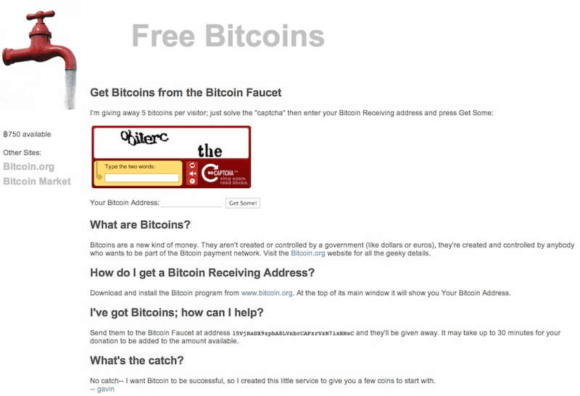
In 2010, Gavin Andresen, one of Bitcoin’s earliest developers, created the first-ever Bitcoin faucet.

the-first-bitcoin-faucet
  • It gave away 5 BTC per user—worth just pennies at the time.
  • The goal was to introduce people to Bitcoin by letting them experience transactions without buying Bitcoin first.
  • Andresen’s faucet distributed 19,700 BTC in total before running out of funds.

That’s now worth millions of dollars—a testament to Bitcoin’s growth since its early days.

Historical Context and Impact

Bitcoin faucets were crucial in:

  • Spreading awareness when Bitcoin was largely unknown.
  • Demonstrating utility by showing how Bitcoin transactions work.
  • Building trust in cryptocurrency by allowing people to test it for free.

Today, faucets serve a similar role, especially as entry points for newcomers exploring Bitcoin and decentralised finance.

For a broader overview of the origins, mechanisms, and impact of Bitcoin faucets, read Bitcoin Faucet Explained—How It Works and Why It Matters.

Key Takeaways

  • Bitcoin faucets distribute free Bitcoin to promote adoption and education.
  • The first faucet by Gavin Andresen gave away 5 BTC per user—a staggering amount in today’s terms.
  • Faucets remain relevant tools for learning about Bitcoin, microtransactions, and blockchain technology.

How Do Bitcoin Faucets Operate?

Bitcoin faucets run on a simple process designed to reward users with small amounts of Bitcoin, called satoshis, for completing basic online tasks.

User Registration Process

To get started, users typically:

  1. Sign Up: Register on the faucet platform with an email address.
  2. Provide a Bitcoin Wallet Address: Users enter a wallet address where rewards will eventually be sent.
  3. Create a Micro Wallet (Optional): Many faucets require a micro wallet to collect small payouts until they reach a minimum withdrawal amount.
  4. Verification (if needed): Some platforms use email confirmation or CAPTCHA tests to prevent bots.

No upfront payments are required, making faucets low-risk and highly accessible.

Types of Tasks Required

Earning Bitcoin from faucets involves completing quick, low-effort tasks, such as:

  • Solving CAPTCHAs: Prove you’re human by identifying letters, numbers, or images.
  • Clicking Ads: View ads and interact with promotional content.
  • Watching Videos: Short advertisements or tutorials related to crypto.
  • Answering Surveys: Provide feedback or opinions in exchange for rewards.
  • Playing Games: Mobile or web-based games that integrate faucet rewards.
  • Refer-a-Friend Programs: Earn commissions by referring new users.

Each task generates revenue for faucet operators through advertising fees, affiliate programs, or sponsorships, allowing them to share a portion of profits with users.

Reward System: Earning Satoshis

  • What Are Satoshis?
    • A satoshi is the smallest Bitcoin unit, equal to 0.00000001 BTC.
  • How Are Rewards Calculated?
    • Most faucets distribute 10–100 satoshis per task, depending on the task’s difficulty and time required.
  • Timers and Frequency:
    • Users may need to wait for a cooldown timer (e.g., 5 minutes) before claiming the next reward.
    • Some faucets offer hourly spins or bonus rewards for consecutive visits.

Role of Micro Wallets in Managing Payouts

Micro wallets are essential tools for faucet users because they:

  • Handle Small Transactions: Store tiny Bitcoin amounts without incurring large blockchain fees.
  • Aggregate Earnings: Collect rewards from multiple faucets in one place until the total reaches the payout threshold.
  • Automate Withdrawals: Transfer funds to a full Bitcoin wallet once the balance hits a set minimum (e.g., 10,000 satoshis).

Example Micro Wallet Providers:

  • FaucetPay – Popular for collecting faucet earnings.
  • CoinPot – Previously used for micro-payouts before closing in 2021.
  • ExpressCrypto – Supports multiple cryptocurrencies in addition to Bitcoin.

Micro wallets make faucets sustainable by solving the problem of high transaction fees for microtransactions.

Key Takeaways

  • Users register, complete simple tasks, and earn satoshis as rewards.
  • Tasks range from captchas and ads to games and surveys.
  • Rewards are collected in micro wallets to minimise fees and simplify withdrawals.
  • The faucet model is scalable and remains an effective way to introduce users to Bitcoin transactions and blockchain technology.

Economic Model Behind Bitcoin Faucets

Bitcoin faucets operate on a simple but effective revenue model that balances earning opportunities for users with profitability for operators. The system is fueled by advertising revenue, affiliate programs, and sponsorships, ensuring faucet platforms remain financially sustainable despite distributing free Bitcoin.

Revenue Generation for Faucet Operators

Bitcoin faucets don’t give away free cryptocurrency out of generosity. Instead, they generate revenue through:

  1. Advertising Revenue:
    • Faucets display ads from Google AdSense, media networks, and crypto ad platforms.
    • Users need to click ads, watch videos, or view pop-ups, which generates income for the faucet owner.
    • Example: High-traffic faucets can earn $1–$10 per 1,000 ad views depending on ad type.
  2. Affiliate Marketing:
    • Users are encouraged to invite others using referral links.
    • Faucets often pay 10–50% commissions on the earnings of referred users.
    • This creates viral growth, driving traffic and more ad revenue.
  3. Sponsorship Deals:
    • Some faucets partner with crypto wallets, exchanges, or mining platforms that pay for exposure.
    • Sponsored content and ads target crypto-curious users visiting these platforms.
  4. Premium Features:
    • Some faucets upsell additional services, like faster withdrawals or higher payouts, generating income directly from users.

Distribution of Earnings to Users

Faucet operators redistribute a portion of their earnings to users in the form of satoshis (fractions of Bitcoin). Here’s how it works:

  • Task Completion: Users perform actions like clicking ads or solving CAPTCHAs to earn points converted into satoshis.
  • Timers and Claim Limits: Faucets often impose a cooldown timer (e.g., 5–15 minutes) between claims to reduce overuse.
  • Daily Limits and Bonuses: Users may receive loyalty rewards or bonuses for visiting regularly.
  • Payout Thresholds: Earnings are stored in micro wallets until users accumulate enough satoshis for withdrawal.

Example Earnings Range:

  • 100–200 satoshis per claim on average.
  • High-paying faucets can offer up to 1,000 satoshis per claim during promotions.
  • Based on data from Coinmetro, faucet users can earn roughly $0.50–$3 per day, depending on activity.

Sustainability Challenges

While faucets were highly profitable in Bitcoin’s early days, sustainability has become a challenge as cryptocurrency values increased.

  1. Lower Rewards Due to Rising Bitcoin Prices:
    • Bitcoin’s value surged, making even small satoshis more expensive to give away.
    • Operators had to lower payouts to avoid losses, reducing user interest.
  2. Ad Revenue Dependency:
    • Revenue fluctuates with advertising rates and traffic volume.
    • Ad blockers further reduce click-based income, impacting faucet profitability.
  3. Fraud and Abuse:
    • Bots and multiple account fraud drain funds, forcing operators to introduce CAPTCHA systems and anti-spam tools.
    • Fraud prevention increases operational costs, cutting into profits.
  4. Transaction Fees and Withdrawals:
    • High Bitcoin transaction fees make micro-payments inefficient.
    • Faucets rely on micro wallets to group payouts, but fees still rise during network congestion.

Key Takeaways

  • Faucets earn money through ads, affiliates, and sponsorships while sharing a fraction of earnings with users.
  • Micro wallets play a critical role in managing payouts, reducing transaction costs.
  • Rising Bitcoin prices and fraudulent activity make faucet operations less profitable over time.
  • New technologies like the Lightning Network could help faucets process payments more efficiently in the future.

Technological Infrastructure of Bitcoin Faucets

Bitcoin faucets rely on efficient payment systems to handle microtransactions, ensuring users can claim small rewards without being affected by high transaction fees. The backbone of this infrastructure includes micro wallets and the Lightning Network, which streamline payments and make the faucet model sustainable.

Micro Wallets: Managing Small Payments

Micro wallets are specialised wallets designed to aggregate small payments before transferring them to a user’s primary Bitcoin wallet.

How They Work:

  • Collection Point: Micro wallets store multiple small transactions (satoshis) earned from faucets.
  • Threshold Limits: Users must reach a minimum balance (e.g., 10,000 satoshis) before transferring funds to their main wallet.
  • Low Transaction Fees: By batching withdrawals, micro wallets reduce the impact of blockchain fees, making tiny payouts viable.

Popular Micro Wallet Providers:

  1. FaucetPay: Supports multiple cryptocurrencies and enables quick payouts.
  2. ExpressCrypto: Previously popular, though it ceased operations in 2022.
  3. CoinPot: Offered combined balances but closed in 2021, reflecting the evolving landscape.

Benefits of Micro Wallets:

  • Efficiency: Prevents paying high transaction fees for small transfers.
  • Consolidation: Combines earnings from multiple faucets into one balance.
  • Automation: Simplifies withdrawals once thresholds are met.

Challenges with Micro Wallets:

  • Centralised Control: Some services require trust in third-party operators, reducing decentralisation.
  • Platform Shutdowns: Users risk losing funds if providers shut down without notice.

The Lightning Network: Boosting Microtransactions

The Lightning Network is a second-layer solution built on Bitcoin’s blockchain. It enables faster and cheaper transactions—a game-changer for faucets and micro-payments.

How It Works:

  • Creates off-chain payment channels between parties, allowing near-instant Bitcoin transfers.
  • Only the opening and closing transactions are recorded on the blockchain, reducing fees.

Benefits for Bitcoin Faucets:

  1. Lower Costs: Transactions are processed off-chain, cutting fees to fractions of a cent.
  2. Speed: Payments clear instantly, unlike regular Bitcoin transactions that can take 10–60 minutes for confirmation.
  3. Scalability: Handles thousands of transactions per second, making it ideal for high-volume platforms like faucets.
  4. Micropayment Support: Makes it profitable to send and receive tiny payments, overcoming Bitcoin’s earlier limitations.

Real-World Impact:

  • Faucets adopting the Lightning Network can now offer instant payouts, removing withdrawal delays.
  • Users avoid network congestion during periods of high blockchain activity, ensuring smooth earnings transfers.

Example Lightning Network Faucets:

  • Bitrefill Faucet: Offers Bitcoin micropayments directly through Lightning.
  • ZEBEDEE: Provides rewards for in-game Bitcoin earnings, leveraging Lightning’s instant transactions.

Key Takeaways

  • Micro wallets streamline Bitcoin faucets by bundling small payments, reducing fees and improving withdrawal efficiency.
  • The Lightning Network allows fast, low-cost microtransactions, making faucets scalable even in periods of high Bitcoin adoption.
  • Combined, these technologies modernise the faucet model, ensuring it remains relevant and profitable despite challenges like rising fees and network congestion.

Educational and Adoption Benefits of Bitcoin Faucets

Bitcoin faucets do more than just hand out free satoshis—they act as learning tools that introduce new users to the cryptocurrency world. By offering a risk-free entry point, faucets lower the barriers to understanding Bitcoin, blockchain technology, and digital payments.

Introducing New Users to Bitcoin

Bitcoin faucets serve as stepping stones for beginners who are curious about cryptocurrency but hesitant to invest their own money.

Key Benefits for New Users:

  • Risk-Free Exploration: Faucets provide small amounts of Bitcoin at no cost, allowing users to experiment without financial commitment.
  • Hands-On Experience: Users actively interact with wallets, transactions, and private keys, gaining practical knowledge.
  • Simplified Onboarding: Faucets break down complex cryptocurrency concepts into simple steps, making Bitcoin accessible to everyone.

Real-World Example:

Early faucets, such as Gavin Andresen’s first Bitcoin faucet, distributed 5 BTC per user in 2010 to boost adoption when Bitcoin was still unknown. This model proved effective, leading to wider public awareness of cryptocurrencies.

Teaching Wallet Creation and Transaction Processing

Bitcoin faucets walk users through critical processes like:

  • Creating a Wallet: Users set up either a micro wallet or a main wallet to store their earnings. This teaches them the importance of:
    • Private keys for security.
    • Seed phrases for backup and recovery.
  • Understanding Transactions: Faucets allow users to:
    • Track transactions on the blockchain using block explorers.
    • Learn how confirmations and fees impact payments.
    • Manage microtransactions effectively through batch payments.
  • Handling Withdrawals: Users experience real-time withdrawals, learning how to send and receive Bitcoin safely.

This step-by-step learning experience prepares users for more advanced interactions with cryptocurrency exchanges and decentralised finance (DeFi) platforms.

Contribution to Broader Cryptocurrency Adoption

Faucets do more than educate individuals—they play a key role in growing the cryptocurrency ecosystem.

Key Contributions:

  • Building Trust in Blockchain Technology: Faucets offer proof-of-concept demonstrations of how Bitcoin works, building confidence in its reliability.
  • Promoting Decentralisation: Users learn about Bitcoin’s role in eliminating intermediaries and enabling peer-to-peer payments.
  • Encouraging Participation in Crypto Markets: After gaining initial exposure through faucets, many users go on to buy, trade, and invest in cryptocurrencies.
  • Driving Innovation in Micropayments: Faucets highlight Bitcoin’s potential for handling microtransactions, paving the way for gaming rewards, loyalty programs, and dApp integrations.

Case Study:

According to a report by CoinDesk, faucets have played a role in onboarding millions of users into Bitcoin, especially in countries with limited access to traditional financial systems.

Key Takeaways

  • Bitcoin faucets provide a hands-on introduction to cryptocurrency for beginners.
  • Users learn about wallet creation, transactions, and security in a practical environment.
  • Faucets act as entry points into the larger crypto world, encouraging participation and investment.
  • They help promote mass adoption by breaking down barriers to entry and offering risk-free exposure.

Case Studies and Statistics on Bitcoin Faucets

Bitcoin faucets have evolved significantly since their inception, offering insights into user engagement, payout structures, and the broader adoption of cryptocurrency. Below are key case studies and statistics that shed light on how faucets have operated over the years and their current state in 2024.

Average Payouts in 2024

Modern Bitcoin Faucets:

  • In 2024, the average faucet pays users a few cents to a couple of dollars per hour, depending on platform traffic and the value of Bitcoin.
  • Low-Reward Faucets: Users typically earn 100–200 satoshis per task (equivalent to $0.02–$0.05 per task at a Bitcoin price of $25,000).
  • High-Reward Faucets: Some faucets offer bonus spins or referral incentives, pushing earnings closer to $1–$3 per hour for highly active users.

Factors Affecting Earnings:

  1. Bitcoin Price Volatility: Rising Bitcoin prices reduce the amount of satoshis distributed.
  2. Task Complexity: Faucets requiring surveys or app downloads may offer higher payouts.
  3. Traffic Volume: Platforms with more users often dilute individual rewards to maintain sustainability.
  4. Historical Impact: Early Faucets Distributing Whole Bitcoins

The First Bitcoin Faucet (2010):

  • Created by Gavin Andresen, the first faucet distributed 5 BTC per user to encourage Bitcoin adoption.
  • At the time, Bitcoin’s value was less than $1, so the giveaways seemed insignificant.

Impact:

  • Over its lifetime, the faucet gave away 19,700 BTC, valued at over $500 million today.
  • It introduced thousands of users to Bitcoin, many of whom became long-term crypto enthusiasts or investors.

Other Early Faucets:

  • During Bitcoin’s early years (2010–2013), many faucets offered 0.1–1 BTC per claim, as transaction fees were negligible.
  • These faucets played a key role in onboarding users who later helped drive Bitcoin’s adoption.

Evolution of User Engagement Over Time

Bitcoin faucets have transformed significantly to adapt to technological and market changes:

2010–2013: The Generous Era

  • High payouts (whole Bitcoins) were common due to low transaction fees and Bitcoin’s minimal market value.
  • Engagement was driven by curiosity about this new digital currency.

2014–2018: Consolidation and Popularity

  • Faucets started focusing on ads and affiliate programs for revenue.
  • Payouts shifted to fractions of Bitcoin, reflecting rising market value.
  • Platforms introduced gamification elements like bonus spins and loyalty rewards to retain users.

2019–2024: Scalability and Adaptation

  • Adoption of micro wallets and the Lightning Network to handle payouts efficiently.
  • Lower payouts due to Bitcoin’s rising value but increased focus on user engagement through surveys, games, and referrals.
  • Faucets diversified, offering multi-crypto payouts to attract a broader audience.

Key Takeaways

  • Earnings Today: Users earn between $0.50–$3 per hour depending on activity level and platform.
  • Historical Generosity: Early faucets like Gavin Andresen’s distributed entire Bitcoins, playing a pivotal role in Bitcoin’s adoption.
  • Evolving Engagement: Faucets have shifted from simple giveaways to more interactive platforms using gamification and ad-based models.

Bitcoin faucets remain relevant as educational tools and onboarding platforms for cryptocurrency, though their economic model has adapted to changing times.

Challenges and Criticisms of Bitcoin Faucets

While Bitcoin faucets have played a significant role in promoting cryptocurrency adoption, they face several challenges that affect their long-term sustainability. From fraud and abuse to declining rewards and user experience issues, faucets must constantly adapt to remain viable.

Fraud and Abuse (Bots and Exploits)

One of the biggest challenges for Bitcoin faucets is fraudulent activity, including:

  • Bot Attacks:
    • Automated programs are often used to repeatedly claim rewards, draining faucet funds quickly and unfairly.
  • Impact:
    • Operators lose revenue and legitimate users receive lower payouts.
  • Multiple Accounts (Sybil Attacks):
    • Users create multiple identities to bypass claim limits and cooldown timers.
  • CAPTCHA Solvers:
    • Fraudsters use automated tools to solve captchas, making it harder for faucets to identify genuine users.
  • IP Address Manipulation:
    • Proxy servers and VPNs are used to bypass IP restrictions, allowing repeated claims.

Countermeasures:

  • Most faucets now require email verification, CAPTCHAs, and IP tracking to prevent abuse.
  • Advanced platforms leverage machine learning algorithms to detect suspicious activity.

Despite these efforts, fraud prevention increases operational costs, impacting faucet profitability.

Declining Rewards Due to Rising Bitcoin Value

Bitcoin’s value has skyrocketed since faucets were first introduced. In 2010, 5 BTC giveaways were worth less than $1. Today, 5 BTC is worth over $200,000, making such payouts unsustainable.

Impact on Earnings:

  • Most faucets now pay only 100–200 satoshis per claim (about $0.02–$0.05), leaving users frustrated with low rewards.
  • Users need to spend hours clicking ads or completing tasks to earn even $1–$3 per day.
  • Faucets have had to reduce payouts further during Bitcoin bull runs, as maintaining high rewards became impossible.

Key Stats (2024):

  • Average faucet earnings: $0.50–$3 per hour based on activity level.
  • Minimum withdrawal thresholds: 10,000–50,000 satoshis, which may take weeks to achieve depending on payouts.

Solutions Being Tested:

  • Integrating the Lightning Network to reduce transaction fees, enabling faster and cheaper payouts.
  • Exploring multi-crypto faucets offering tokens like Dogecoin and Litecoin, which are more affordable for microtransactions.

User Experience Concerns

Many faucets have shifted their focus toward ads and affiliate programs, sometimes at the expense of user experience.

Common Complaints:

  • Intrusive Ads:
    • Pop-ups, redirects, and auto-play videos frustrate users and create a spammy experience.
  • Lengthy Payout Processes:
    • Users often have to wait weeks or months to reach the minimum payout amount.
  • Hidden Fees:
    • Some faucets charge withdrawal fees, further reducing actual earnings.
  • Trust Issues:
    • Many faucets shut down unexpectedly, leaving users unable to withdraw funds.
    • Users are often sceptical of new faucets due to scams and rug pulls.

Improvements Needed:

  • Better user interface designs to simplify navigation.
  • Transparent payout systems to build trust.
  • Improved mobile compatibility, as more users access faucets via smartphones.

Key Takeaways

  • Fraud and Abuse: Bots, VPNs, and CAPTCHA solvers make faucet management expensive and complex.
  • Lower Rewards: Rising Bitcoin values have drastically reduced payouts, limiting user earnings.
  • Poor User Experience: Ad-heavy platforms and long payout delays lead to user dissatisfaction.

Future Outlook:

Bitcoin faucets need to evolve by:

  • Leveraging technologies like the Lightning Network to reduce costs.
  • Offering multi-crypto rewards to sustain higher payouts.
  • Improving security systems to block fraudulent activity and enhancing user experiences for better retention.

Future Prospects of Bitcoin Faucets

Bitcoin faucets continue to evolve as technology advances and cryptocurrency adoption grows. While traditional faucet models face challenges, new opportunities have emerged through decentralised applications (dApps), blockchain innovations, and layer-2 solutions like the Lightning Network. These advancements are helping faucets stay relevant in the ever-changing crypto landscape.

Adaptation to New Technologies and Platforms

Bitcoin faucets are embracing modern technologies to improve efficiency and user experience:

  • Lightning Network Integration:
    • Faucets are adopting the Lightning Network to handle instant micropayments with lower fees.
    • This allows faucets to offer faster withdrawals and higher payouts, addressing one of their biggest challenges—transaction costs.
  • Mobile and Web3 Applications:
    • Faucets are moving to mobile-friendly platforms and integrating with Web3 wallets to simplify access.
      • Example: Some faucets now allow users to connect their MetaMask wallets or scan QR codes for payments, enabling a seamless experience.
  • Gamification and Rewards Systems:
    • Modern faucets incorporate games, quizzes, and challenges to keep users engaged.
    • Platforms like ZEBEDEE even offer Bitcoin rewards for in-game actions, blurring the line between gaming and earning.
  • Multi-Crypto Support:
    • Many faucets now distribute multiple cryptocurrencies, catering to the growing interest in altcoins and tokenised assets like Ethereum and Dogecoin.

Integration with Decentralised Applications (dApps)

Decentralised applications (dApps) offer exciting opportunities for Bitcoin faucets to grow beyond their current use cases:

  • Smart Contract Faucets:
    • Faucets can be built directly on Ethereum, Polygon, or other blockchain networks using smart contracts to automate payouts and improve transparency.
  • dApp Partnerships:
    • Faucets can integrate with DeFi platforms and NFT marketplaces, allowing users to earn Bitcoin rewards while interacting with decentralised finance tools or purchasing NFTs.
  • Token Rewards and Staking Incentives:
    • Faucets may evolve to include staking programs, where users lock up cryptocurrency to earn additional rewards, combining faucets with yield farming concepts.
  • Micropayment Infrastructure for dApps:
    • Faucets could power microtransactions within dApps, enabling payments for content, services, or gaming rewards without traditional payment systems.

Ongoing Relevance in the Cryptocurrency Landscape

Despite challenges, Bitcoin faucets remain relevant as:

  • Educational Tools:
    • Faucets continue to provide hands-on training for new users, teaching them about wallets, transactions, and blockchain security.
  • Low-Risk Entry Points:
    • Faucets allow curious users to experiment with cryptocurrencies without the risk of losing money.
  • Marketing Channels:
    • Cryptocurrency companies use faucets as advertising platforms to promote their products, services, and tokens.
  • Scaling Opportunities with Layer-2 Solutions:
    • Technologies like the Lightning Network make faucets more sustainable by reducing fees and speeding up payments, keeping faucets practical even with small payouts.
  • Web3 and Metaverse Integration:
    • Faucets could be integrated into metaverse platforms, offering users rewards for virtual activities, enhancing engagement in virtual economies.

Key Takeaways

  • Bitcoin faucets are adapting to modern technologies like the Lightning Network and Web3 wallets to improve scalability and efficiency.
  • Integrations with decentralised applications (dApps) could expand their functionality, merging them with DeFi tools and gaming platforms.
  • Faucets remain relevant by acting as educational tools, marketing platforms, and gateways to broader cryptocurrency adoption.
  • As the crypto ecosystem evolves, faucets will likely become part of larger decentralised infrastructures, enabling microtransactions and rewards systems in the digital economy.

Conclusion: The Role and Impact of Bitcoin Faucets

Bitcoin faucets have played a pivotal role in introducing millions of people to the cryptocurrency world. Starting as simple giveaways of whole Bitcoins in 2010, faucets have evolved into interactive platforms that educate users, promote blockchain adoption, and demonstrate the potential of microtransactions.

They’ve proven to be:

  • Educational Tools: Teaching users about wallets, transactions, and blockchain security without financial risks.
  • Onboarding Platforms: Lowering barriers to entry for newcomers, making cryptocurrency more accessible.
  • Marketing Channels: Offering businesses a way to reach crypto-savvy audiences through ads and referrals.
  • Proof-of-Concept Systems: Highlighting Bitcoin’s ability to handle micropayments efficiently.

Final Thoughts on Their Significance in the Digital Economy

Bitcoin faucets continue to adapt as cryptocurrency technologies advance. With innovations like the Lightning Network and Web3 integrations, faucets remain relevant tools for educating users and enabling low-cost transactions.

Looking ahead:

  • Faucets are likely to become part of decentralised applications (dApps) and gaming ecosystems, offering rewards through blockchain-powered platforms.
  • They will maintain their role as entry points for crypto adoption, providing low-risk learning environments for beginners.
  • As digital economies expand, faucets could support micropayment systems and tokenised incentives, reinforcing Bitcoin’s value beyond speculation and trading.

While individual faucet platforms may come and go, the core concept of using microtransactions to engage users and promote adoption will continue to influence the cryptocurrency ecosystem.

Categories
Guides

Bitcoin Faucets Explained: How They Work and Why It Matters

Bitcoin Faucets Explained: How They Work and Why It Matters

Bitcoin Faucets Explained: Introduction

What Is a Bitcoin Faucet?

A Bitcoin faucet is a platform or tool that distributes small amounts of Bitcoin to users as rewards for completing simple tasks. These tasks may include solving captchas, watching ads, clicking links, or playing mini-games. Faucets were created as a way to promote Bitcoin adoption by allowing people to interact with cryptocurrency without the need for initial investment.

Think of Bitcoin faucets as free samples of Bitcoin, designed to get users comfortable with using digital wallets and making transactions. They also highlight how microtransactions work on the Bitcoin network, providing hands-on experience with cryptocurrency.

Purpose of Bitcoin Faucets

  • Promote Bitcoin Adoption – Faucets introduce Bitcoin to beginners by providing free tokens to experiment with. Users can learn to set up wallets, send and receive Bitcoin, and experience blockchain transactions firsthand.
  • Hands-On Learning Tool – They make Bitcoin approachable by removing the financial risk. Users gain confidence in managing cryptocurrency while earning small amounts.
  • Demonstrate Bitcoin Technology – Faucets showcase Bitcoin’s ability to handle microtransactions, reinforcing its practical applications in real-world scenarios.

Why Do Bitcoin Faucets Still Matter?

Despite Bitcoin’s growth and increased value, faucets remain relevant for several reasons:

  1. Educational Resource
    • Help beginners understand how Bitcoin works—from setting up wallets to making transactions.
    • Provide real-world exposure to blockchain concepts without requiring a financial commitment.
  2. Passive Income Potential
    • Offer small but steady earnings through tasks, making them attractive for users exploring passive income streams.
    • Referral programs often provide bonuses for bringing in new users, amplifying earnings.
  3. Microtransaction Demonstration
    • Highlight Bitcoin’s efficiency in handling tiny payments.
    • Encourage exploration of technologies like the Lightning Network, which optimises Bitcoin’s scalability for microtransactions.

For a more detailed exploration of why Bitcoin faucets continue to be valuable tools for education, accessibility, and adoption, check out Benefits of Bitcoin Faucets: Promoting Accessibility and Adoption. This article dives into how faucets empower users by offering a risk-free entry into cryptocurrency while showcasing Bitcoin’s practical applications in microtransactions.

Key Things to Know About Bitcoin Faucets

  • Risk-Free Entry Point – Perfect for newcomers to cryptocurrency who want to learn without investing money.
  • Simple Tasks, Real Rewards – Users complete easy actions to earn satoshis, the smallest unit of Bitcoin.
  • Ad-Supported Model – Faucets sustain themselves through advertising revenue, distributing a portion as rewards.
  • Wallet Integration – Most faucets require users to connect a Bitcoin wallet to receive payouts, reinforcing wallet setup practices.
  • Low Payouts, High Learning Value – While rewards are small, the experience gained is often more valuable than the earnings themselves.

Stay tuned as we explore how Bitcoin faucets work, their history, and the types available in the following sections!

The History of Bitcoin Faucets

Early Days (2010)

Bitcoin faucets trace their origins back to 2010, just one year after Bitcoin’s launch.

the-first-bitcoin-faucet
  • Invented by Gavin Andresen – A key developer in Bitcoin’s early growth.
  • First Faucet Payouts – Distributed 5 BTC per claim (worth only a few cents at the time).
  • Purpose – Designed to encourage people to explore and experiment with Bitcoin by giving them free coins.

At the time, Bitcoin was an experimental concept with almost no mainstream adoption. Faucets served as a tool to spread awareness, educate users, and get more people to set up Bitcoin wallets.

Why Were Bitcoin Faucets Created?

Bitcoin faucets were designed to solve two early challenges in cryptocurrency adoption:

  1. Encouraging Experimentation
    • Faucets gave people a way to try out blockchain technology without the fear of losing money.
    • Users could practice sending and receiving Bitcoin, helping them understand wallet management.
  2. Demonstrating Decentralisation
    • Faucets highlighted Bitcoin’s ability to process peer-to-peer payments without middlemen.
    • They showed that small transactions could be sent anywhere in the world quickly and cheaply.
  3. Driving Adoption
    • Distributing free Bitcoin helped generate buzz and build a user base when interest was low.
    • Faucets allowed everyday people to experience owning cryptocurrency.

Evolution Over Time

As Bitcoin grew in value, the faucet model needed to adapt to keep up with market changes:

  1. Payout Adjustments
    • Early faucets gave away whole Bitcoins.
    • As Bitcoin’s price surged, rewards shifted to satoshis (fractions of Bitcoin).
  2. Ad-Supported Revenue Models
    • Faucets began relying on advertisements to fund payouts.
    • Users earned Bitcoin while interacting with ads, surveys, and games—turning faucets into a micro-task economy.
  3. Technological Upgrades
    • Modern faucets now integrate with the Lightning Network to handle faster, cheaper microtransactions.
    • This allows faucets to process payouts almost instantly while reducing transaction fees.
  4. Diversification
    • Today’s faucets aren’t limited to Bitcoin. Many support multiple cryptocurrencies, expanding options for users and broadening their appeal.

Key Takeaways

  • Bitcoin Faucets Started Small: They distributed entire Bitcoins to get people interested in crypto.
  • Adapting to Growth: Over time, faucets evolved from simple giveaways to ad-driven platforms offering micro-earnings.
  • Tech-Enabled Scalability: With tools like the Lightning Network, faucets continue to operate efficiently, even as Bitcoin’s value rises.
  • Evergreen Purpose: While payouts are smaller today, faucets remain a gateway for education and adoption, proving their long-term value.

How Bitcoin Faucets Work

Step-by-Step Process

1. Sign Up

  • Users create an account on a Bitcoin faucet website or app.
  • A Bitcoin wallet address is required to receive rewards.
  • Some faucets allow quick access without registration, but accounts are usually required for larger payouts and referrals.

2. Complete Tasks

  • Faucets reward users for engaging in small activities such as:
    • Solving captchas – Prove you’re human to prevent bots.
    • Watching ads or videos – View sponsored content for payouts.
    • Playing games – Earn rewards by reaching milestones or achieving scores.
    • Taking surveys – Share opinions and data for payouts.
    • Spinning wheels or lottery systems – Introduce randomness and gamification for engagement.

3. Claim Rewards

  • After completing tasks, users earn small amounts of Bitcoin called satoshis (fractions of a Bitcoin).
  • Claims may be allowed every few minutes or at set intervals, depending on the faucet.

4. Withdraw Earnings

  • Users can withdraw their earnings after reaching a minimum payout threshold, which varies by platform.
  • Funds are transferred to the connected Bitcoin wallet, either manually or automatically.
  • Some faucets support Lightning Network withdrawals, allowing faster and cheaper transactions.

For a deeper breakdown of the process and its practical applications, check out our comprehensive guide—How Bitcoin Faucets Work: A Guide to Earning Free Bitcoin.

Revenue Model

How Do Faucets Make Money?

Bitcoin faucets are ad-driven platforms designed to generate revenue while distributing rewards:

  • Advertising Revenue
    • Faucets display banner ads, video ads, and pop-ups to generate income.
    • Users interact with ads during tasks, which creates earnings for the faucet owner.
  • Affiliate Marketing
    • Many faucets promote affiliate offers or referral programs.
    • Users can earn bonuses by inviting others, helping faucets grow their audience.
  • Partnership Deals
    • Faucets may partner with cryptocurrency exchanges or wallet providers, earning commissions for referrals.
  • Premium Memberships
    • Some faucets offer paid tiers for higher payouts or exclusive tasks, creating an additional revenue stream.

This business model allows faucets to operate without requiring upfront payments from users while maintaining profitability.

Key Terms to Know

  • Satoshi
    • The smallest unit of Bitcoin, equal to 0.00000001 BTC.
    • Named after Satoshi Nakamoto, Bitcoin’s anonymous creator.
  • Wallet
    • A digital storage tool for holding Bitcoin securely.
    • Wallets come in different forms: software wallets (apps), hardware wallets (physical devices), and online wallets.
  • Microtransactions
    • Small-scale payments often used in online platforms, gaming, and faucets.
    • Enabled by Bitcoin’s divisibility and scalability features, especially through the Lightning Network.

Key Takeaways

  • No Investment Required: Bitcoin faucets are free to use, making them accessible to anyone with a smartphone or computer.
  • Low Payouts, Consistent Earnings: Users earn in small increments, but combining tasks and referrals can lead to steady accumulation over time.
  • Ad-Based Revenue Model: Faucets sustain payouts by monetising traffic through ads, affiliates, and premium features.
  • Built for Microtransactions: Faucets highlight Bitcoin’s ability to handle low-cost, small payments, demonstrating its real-world usability.

Types of Bitcoin Faucets

Bitcoin faucets have evolved to cater to different user preferences, offering a variety of ways to earn Bitcoin and even other cryptocurrencies. Here’s a breakdown of the most common types:

Standard Faucets

freebitco.in bitcoin faucet-site
  • How They Work – Users earn rewards by completing simple tasks like:
    • Solving captchas to prove they’re human.
    • Clicking ads or visiting sponsored websites.
    • Watching short promotional videos.
  • Best For – Beginners looking to earn their first Bitcoin without much effort.
  • Key Feature – Regular claims with cooldown timers (e.g., every 5–15 minutes).

Game-Based Faucets

satoshi hero bitcoin casino games
  • How They Work – Users earn Bitcoin by playing mini-games or achieving milestones in challenges.
  • Examples of Tasks
    • Spin-the-Wheel Games – Luck-based payouts.
    • Puzzle Challenges – Solve puzzles to unlock rewards.
    • Role-Playing Games (RPGs) – Complete levels or missions for payouts.
  • Best For – Gamers who want to combine fun with earning Bitcoin.
  • Key Feature – Engagement-focused platforms with addictive tasks.

Survey Faucets

Cointiplu Bitcoin Rewards
  • How They Work – Users earn Bitcoin by completing surveys and submitting feedback.
  • Examples of Tasks
    • Product reviews.
    • User experience surveys.
    • Market research questionnaires.
  • Best For – Users comfortable sharing opinions and demographic data.
  • Key Feature – Higher payouts compared to other faucets but takes more time per task.

Referral Faucets

highest-paying-crypto-bitcoin-faucet
  • How They Work – Users earn bonuses by inviting new members to the platform.
  • Examples of Earnings
    • Fixed bonuses when referrals sign up.
    • Ongoing commissions based on referral earnings.
  • Best For – Users with strong social networks or marketing skills.
  • Key Feature – Passive income potential through long-term referral earnings.

Multi-Coin Faucets

firefaucet-auto-faucet
  • How They Work – Platforms that distribute not just Bitcoin, but also other cryptocurrencies like:
    • Ethereum (ETH)
    • Litecoin (LTC)
    • Dogecoin (DOGE)
    • Ripple (XRP)
  • Best For – Users interested in building a diverse cryptocurrency portfolio.
  • Key Feature – Flexible earning options across multiple coins.

Key Takeaways

  • Diverse Earning Methods – From simple captchas to fun games and surveys, faucets cater to different user interests.
  • Referral Bonuses Boost Income – Users can multiply earnings through referral programs, making them ideal for those with strong networks.
  • Multi-Coin Options Expand Portfolios – Faucets offering multiple cryptocurrencies allow users to experiment beyond Bitcoin.
  • Entertainment + Earnings – Game-based faucets make earning Bitcoin enjoyable, while surveys offer higher payouts for more effort.

Benefits of Using Bitcoin Faucets

Bitcoin faucets offer several advantages that make them appealing to both beginners and experienced cryptocurrency enthusiasts. Whether you’re exploring Bitcoin for the first time or looking for ways to earn small, consistent rewards, faucets provide value in multiple ways.

Free Bitcoin Access

  • No Investment Required – Faucets provide a completely risk-free way to acquire Bitcoin.
  • Accessibility for Everyone – Users only need an internet connection and a Bitcoin wallet—no purchases or deposits are necessary.
  • Exposure to Bitcoin – Faucets give beginners the chance to own Bitcoin, even if they’re hesitant to invest their own money.

Key Takeaway: Faucets break down financial barriers, allowing anyone to start earning Bitcoin immediately.

Hands-On Learning

  • Practical Experience – Users learn how to create wallets, receive payments, and transfer Bitcoin.
  • Blockchain Familiarity – Faucets act as interactive tutorials, showing users how transactions are recorded on the blockchain.
  • Confidence Building – Beginners can experiment without the fear of making costly mistakes.

Key Takeaway: Faucets act as an educational sandbox for those new to cryptocurrency.

Low-Risk Introduction to Crypto

  • No Financial Loss – Users earn Bitcoin instead of risking their own funds, making faucets ideal for cautious learners.
  • Testing Ground for Strategies – Users can experiment with crypto storage, trading, and transfers before committing larger investments.
  • Learning Tool for Market Trends – Faucets help users follow market price movements and understand how Bitcoin value fluctuates.

Key Takeaway: Faucets remove the fear of loss, encouraging participation in cryptocurrency markets.

Decentralisation Showcase

  • Peer-to-Peer Payments – Faucets highlight how Bitcoin enables direct, trustless transactions without banks or intermediaries.
  • Real-World Applications – Users experience firsthand how Bitcoin operates as digital cash, reinforcing its potential for global payments.
  • Microtransaction Utility – Faucets demonstrate the practicality of small payments, especially with technologies like the Lightning Network.

Key Takeaway: Faucets showcase Bitcoin’s core philosophy of decentralisation and global accessibility.

Passive Income Potential

  • Steady Earnings Over Time – While rewards are small, consistent usage and referrals can lead to long-term accumulation.
  • Referral Programs Multiply Income – Inviting new users boosts earnings, turning faucets into a low-effort passive income stream.
  • Gamified Earning – Game-based faucets make earning Bitcoin fun and engaging, keeping users motivated to return.

Key Takeaway: Faucets provide a gateway to passive income, especially for users who actively promote referral programs.

Key Benefits Recap

  • Free and Accessible – Faucets make Bitcoin ownership possible without any financial commitment.
  • Educational Tool – Hands-on learning helps users grasp crypto fundamentals safely.
  • Risk-Free Crypto Exposure – Faucets build confidence without requiring an initial investment.
  • Decentralization in Action – Users see Bitcoin’s potential for peer-to-peer payments and microtransactions.
  • Passive Income Streams – Referrals and consistent participation lead to cumulative earnings.

Challenges and Risks of Bitcoin Faucets

While Bitcoin faucets offer free access to cryptocurrency and educational opportunities, they also come with several challenges and risks that users need to be aware of. Here’s a breakdown of the key issues:

Legitimacy Issues

  • Scams and Fraudulent Faucets – Many faucets promise payouts but never actually send rewards.
  • Phishing Attacks – Some malicious sites attempt to steal wallet information or personal data.
  • Hidden Fees or Malware – Certain faucets may require software downloads, potentially exposing users to malware or viruses.

How to Avoid Scams:

  • Verify Trustworthiness – Stick to reputable platforms with positive reviews and high user ratings.
  • Use Secure Wallets – Only connect faucets to wallets designed for microtransactions, avoiding large balances in linked accounts.
  • No Downloads Required – Avoid any faucet that asks for software downloads.

Key Takeaway: Always research faucet platforms thoroughly before signing up to ensure legitimacy and security.

Low Payouts

  • Minimal Rewards – Faucets distribute tiny fractions of Bitcoin (satoshis), often requiring extended participation to see meaningful earnings.
  • Patience Required – Building up enough Bitcoin to make a withdrawal may take days, weeks, or even months.
  • Time-Consuming – Tasks can be repetitive, and earnings often don’t justify the effort for users looking for quick income.

How to Maximise Earnings:

  • Focus on faucets with referral programs to boost earnings passively.
  • Combine multiple faucets for higher cumulative payouts.
  • Prioritise platforms with low withdrawal thresholds to cash out faster.

Key Takeaway: Faucets aren’t designed to make users rich—they’re more about learning and earning small amounts over time.

Ad-Dependence

  • Revenue-Based Model – Faucets rely heavily on advertising revenue to fund payouts.
  • Sustainability Risks – If ad revenue drops, faucet operators may reduce payouts or shut down entirely.
  • User Experience Issues – Excessive ads, pop-ups, and redirects can make faucets frustrating to use.

How to Handle Ad Overload:

  • Use a dedicated browser or device to keep faucet activities separate from personal browsing.
  • Prioritise faucets with clean interfaces and limited ad interruptions.
  • Consider premium memberships on platforms that reduce ads in exchange for fees (if the earnings justify it).

Key Takeaway: Faucets are dependent on ad revenue, which may affect payout reliability and overall user experience.

Withdrawal Thresholds

  • High Minimum Payouts – Many faucets require users to accumulate a certain balance before allowing withdrawals, often delaying access to funds.
  • Inactive Accounts – Some faucets reset balances if accounts remain inactive, causing users to lose earnings.
  • Hidden Fees – Withdrawal processing fees may further reduce payouts.

How to Avoid Withdrawal Issues:

  • Look for faucets with low payout thresholds and automatic withdrawal options.
  • Stay active on platforms to avoid balance resets.
  • Read terms and conditions carefully before investing time into a faucet.

Key Takeaway: Always check payout policies in advance to avoid frustration and lost earnings.

Key Challenges Recap

  1. Legitimacy Risks – Fraudulent faucets and phishing attempts can compromise security.
  2. Low Earnings – Payouts are small, making faucets unsuitable for those seeking quick profits.
  3. Ad Dependency – Faucets rely on ad revenue, which affects sustainability and user experience.
  4. Withdrawal Limits – High thresholds and fees can make accessing earnings time-consuming.

Final Thoughts on Challenges and Risks

While Bitcoin faucets remain valuable tools for learning and experimenting, they come with limitations that users need to approach with realistic expectations. By sticking to trusted platforms, leveraging referral programs, and managing expectations about earnings, users can minimise risks and make the most out of faucets.

Modern Adaptations and Technology

Bitcoin faucets have evolved significantly since their inception, adapting to new technologies and market demands to stay relevant. These advancements make faucets more efficient, scalable, and versatile than ever before. Here’s how modern faucets have adapted:

Lightning Network Integration

The Lightning Network is one of the most transformative upgrades for Bitcoin faucets.

  • Faster Transactions – Payments process almost instantly, solving the delays associated with Bitcoin’s main blockchain.
  • Lower Fees – Microtransactions are now cost-effective, making faucets sustainable even with small payouts.
  • Scalability – Faucets can handle higher traffic without bottlenecks, supporting thousands of users simultaneously.
  • User Benefits – Users can claim and withdraw rewards more frequently without worrying about high fees or wait times.

Example Use Case: A faucet using the Lightning Network can allow instant withdrawals to wallets supporting the protocol, eliminating long wait periods.

Key Takeaway: Faucets leverage the Lightning Network to handle microtransactions quickly and cheaply, keeping them relevant in a fast-moving crypto economy.

Automated Systems

Modern faucets now use automation to streamline operations and improve user experience:

  • Seamless Claims – Users can set up auto-claims to collect rewards without manual input.
  • Scheduled Payouts – Earnings are automatically sent to wallets once minimum thresholds are met.
  • Fraud Prevention – Automated systems detect and block bots or suspicious activity, ensuring legitimate users receive payouts.
  • Improved Security – Two-factor authentication (2FA) and wallet encryption features are now standard.

Example Use Case: Faucets with auto-claim features allow users to earn rewards while multitasking, increasing efficiency.

Key Takeaway: Automation has made faucets faster, safer, and easier to use, removing manual processes and reducing fraud.

Multi-Coin Support

Modern faucets are no longer limited to Bitcoin—they now support multiple cryptocurrencies:

  • Diversified Options – Popular coins supported include:
    • Ethereum (ETH) – Smart contract compatibility.
    • Litecoin (LTC) – Faster and cheaper transactions.
    • Dogecoin (DOGE) – Known for meme culture and low fees.
    • Ripple (XRP) – Focused on cross-border payments.
  • Portfolio Growth – Users can earn and experiment with multiple coins, diversifying their holdings.
  • User Choice – Faucets let users switch between cryptocurrencies, depending on payout rates and market trends.
  • Scalability – Supporting multiple coins helps faucets reach wider audiences, attracting users interested in various cryptocurrencies.

Example Use Case: A faucet offering Ethereum rewards alongside Bitcoin appeals to users exploring decentralised finance (DeFi) ecosystems.

Key Takeaway: Multi-coin support keeps faucets aligned with market trends, appealing to users beyond Bitcoin enthusiasts.

Key Benefits of Modern Technology in Faucets

  • Speed and Cost Efficiency – The Lightning Network enables instant payouts with low fees.
  • Automation Enhances Usability – Faucets now handle claims, payouts, and security seamlessly.
  • Multi-Coin Flexibility – Users can earn various cryptocurrencies, diversifying their earnings and exposure.
  • Scalability and Security – Advanced fraud detection and automated systems make faucets more reliable and secure for users.

Looking Ahead

As cryptocurrency continues to evolve, faucets are likely to incorporate new technologies like:

  • Smart Contracts – Enabling conditional payments and decentralised rewards.
  • NFT Rewards – Faucets may integrate non-fungible tokens as an alternative earning option.
  • Decentralised Faucets – Built entirely on blockchain networks to remove centralised control.
  • Mobile Integration – More faucets are optimising for mobile apps, improving accessibility.

Frequently Asked Questions (FAQs)

Bitcoin faucets are popular among beginners exploring cryptocurrency, but they also raise many questions about legitimacy, earnings, and how they operate. Below are the most common questions and straightforward answers to help clear up any confusion:

Are Bitcoin Faucets Legit?

Yes, many Bitcoin faucets are legitimate, but users must be cautious.

  • Trusted Platforms Only – Stick to faucets with positive reviews, verified payouts, and active communities.
  • Avoid Scams – Watch out for fake sites that never pay or collect user data without permission.
  • Quick Tips:
    • Use a temporary email address when signing up.
    • Test with small claims before investing significant time.
    • Check faucet reviews on crypto forums or platforms like Trustpilot.

Key Takeaway: Legitimate faucets exist, but thorough research is essential to avoid scams.

How Much Can You Earn from Bitcoin Faucets?

Earnings vary widely depending on the faucet and the user’s activity:

  • Per Claim: Typically 1–100 satoshis (fractions of Bitcoin).
  • Daily Earnings: Consistent users may earn a few cents to a couple of dollars per day.
  • Referral Bonuses: Users can increase earnings significantly through referral programs.

Example Calculation:

10 satoshis per claim x 50 claims = 500 satoshis/day

With Bitcoin at $50,000, this equals $0.25 per day—small but scalable with referrals.

Key Takeaway: Bitcoin faucets offer small but steady earnings, especially when combined with referral programs.

How Often Can You Claim Rewards?

Most faucets operate on timed intervals:

  • Every Few Minutes – Common cooldown periods are 5–15 minutes between claims.
  • Hourly or Daily Limits – Some faucets have maximum claims per day to control payouts.
  • Auto-Claim Options – Modern faucets allow automated claims, reducing manual effort.

Key Takeaway: Users can make frequent claims, but timing restrictions may limit the speed of earnings.

Do Faucets Require Any Investment?

No, Bitcoin faucets are completely free to use and do not require any upfront investment.

  • Users only need:
    • A Bitcoin wallet to receive earnings.
    • An email address to register accounts.
  • Time and effort are the only investments required.

Key Takeaway: Faucets are an accessible entry point into Bitcoin with zero financial risk.

How Do Bitcoin Faucets Make Money?

Faucets operate on an advertising-based model, generating revenue through:

  • Ad Impressions and Clicks – Displaying banners, pop-ups, and video ads.
  • Affiliate Marketing – Promoting third-party products and services for commissions.
  • Premium Upgrades – Offering paid memberships for higher payouts or ad-free experiences.
  • Referral Systems – Encouraging users to invite others, growing their audience and ad views.

Key Takeaway: Faucets share a portion of their ad revenue with users, making it a win-win model.

What’s the Minimum Withdrawal Threshold?

  • Varies by platform—some allow withdrawals at 1,000 satoshis, while others may require 10,000 satoshis or more.
  • Modern faucets with Lightning Network integration offer lower thresholds and faster payouts.

Key Takeaway: Always check withdrawal policies before investing time into any faucet.

Can Faucets Be Used for Passive Income?

Yes, but with limitations:

  • Referrals Are Key – Passive income grows by inviting others through affiliate programs.
  • Stack Multiple Faucets – Using several faucets at once can increase overall earnings.
  • Automation Tools – Some faucets allow auto-claims, reducing manual effort.

Key Takeaway: Faucets can supplement income but are not a substitute for full-time earnings.

Are There Faucets for Other Cryptocurrencies?

Yes, many modern faucets support multiple cryptocurrencies, including:

  • Ethereum (ETH)
  • Litecoin (LTC)
  • Dogecoin (DOGE)
  • Ripple (XRP)

Key Takeaway: Multi-coin faucets allow users to build a diverse crypto portfolio.

Do Bitcoin Faucets Work on Mobile Devices?

Yes, most modern faucets are optimised for mobile devices or offer dedicated apps.

  • Users can claim rewards, complete tasks, and withdraw earnings on the go.
  • Mobile-friendly faucets cater to global users who rely on smartphones.

Key Takeaway: Mobile compatibility makes faucets accessible anytime, anywhere.

Are There Any Risks With Bitcoin Faucets?

Yes, common risks include:

  • Scams and Phishing – Fake faucets that steal data or funds.
  • Ad Spam – Overloaded ads leading to poor user experience.
  • Withdrawal Delays – High payout thresholds or hidden fees.

Key Takeaway: Users must choose trusted platforms and protect their wallet information to avoid risks.

Final Thoughts on FAQs

Bitcoin faucets are an easy, risk-free way to experiment with cryptocurrency, but managing expectations is key. Users should focus on:

  • Legitimate platforms with good reviews.
  • Referral programs to maximise earnings.
  • Multiple faucets to scale up daily income.

Final Thoughts: Why Bitcoin Faucets Still Matter

Bitcoin faucets have stood the test of time, evolving alongside the cryptocurrency landscape. While their payouts are small, their impact is massive, particularly for beginners entering the crypto world.

Entry-Level Tools for Cryptocurrency Adoption

  • Faucets remain one of the easiest ways to experience Bitcoin without any upfront investment.
  • They help users understand wallets, transactions, and blockchain mechanics by offering hands-on learning.
  • For those new to cryptocurrency, faucets provide risk-free exposure, building confidence before larger investments.

Key Takeaway: Faucets continue to serve as onboarding tools, introducing millions to Bitcoin and blockchain technology.

Highlighting Bitcoin’s Utility for Microtransactions

  • Faucets demonstrate how Bitcoin’s divisibility allows it to handle tiny payments—a feature unmatched by traditional financial systems.
  • The rise of the Lightning Network has further reinforced Bitcoin’s role in fast and low-cost microtransactions, making faucets more scalable.
  • This model showcases Bitcoin’s ability to support real-world use cases, from tipping content creators to enabling micropayments in digital economies.

Key Takeaway: Faucets emphasise Bitcoin’s practicality for everyday payments, beyond just long-term storage of value.

Evolving With Blockchain Technology

  • Modern faucets integrate with tools like the Lightning Network for faster, cheaper transactions.
  • Multi-coin support allows users to explore Ethereum, Litecoin, and other cryptocurrencies, adapting to broader market trends.
  • Automated systems ensure seamless claims, security, and payouts, improving reliability.
  • Faucets are also testing grounds for innovations like NFTs and DeFi applications, showing their ability to evolve.

Key Takeaway: Faucets adapt to new technologies, proving their relevance even as the crypto market advances.

Passive Income Opportunities

  • Although payouts are small, faucets offer ways to earn passive income through referral programs and consistent claims.
  • Combined with automation tools, users can scale earnings with minimal ongoing effort.
  • For many, faucets provide a stepping stone to more profitable crypto ventures, like staking and trading.

Key Takeaway: Faucets open the door to long-term earning strategies, especially for those willing to put in consistent effort.

Evergreen Educational Value

  • Faucets aren’t just about earning—they’re also learning platforms for understanding Bitcoin’s mechanics.
  • They reinforce Bitcoin’s decentralised philosophy and show its practical applications in payments and rewards systems.
  • Whether for newcomers or enthusiasts, faucets remain a low-risk way to test wallets and transactions.

Key Takeaway: Faucets double as educational tools, bridging the gap between theory and practice.

Why Faucets Are Here to Stay

Bitcoin faucets continue to stay relevant by:

  1. Lowering Barriers to Entry – No investment needed to start earning.
  2. Promoting Adoption – Teaching millions how Bitcoin works.
  3. Showcasing Microtransactions – Proving Bitcoin’s scalability for small payments.
  4. Adapting to Innovation – Evolving with technologies like the Lightning Network and multi-coin support.

Final Takeaway: Faucets reflect the core values of Bitcoin—decentralisation, accessibility, and financial inclusion—and will likely remain a gateway to cryptocurrency as the industry continues to grow.

Categories
Insights

Bitcoin Faucets: Micro-Mining for Crypto Accumulation in 2025

Bitcoin Faucets: Micro-Mining for Crypto Accumulation in 2025

Bitcoin has come a long way since its launch in 2009. Initially dismissed as a niche experiment, it has grown into a global financial phenomenon, influencing industries and challenging traditional monetary systems. Its decentralised nature, capped supply of 21 million coins, and growing institutional adoption have positioned Bitcoin as “digital gold” in the modern economy.

Today, Bitcoin isn’t just for tech-savvy enthusiasts or deep-pocketed investors. With a limited supply and increasing demand from entities like corporations and ETFs, individual participation can feel out of reach. That’s where Bitcoin faucets come into play.

What are Bitcoin Faucets?

Bitcoin faucets are platforms that distribute small amounts of Bitcoin (satoshis) for free or in exchange for completing simple tasks. They offer an accessible way to accumulate Bitcoin without large upfront costs, acting as a bridge for newcomers into the crypto ecosystem.

Whether it’s solving captchas, playing games, or watching ads, faucets democratise Bitcoin ownership by allowing anyone with an internet connection to start building their micro-reserves. This concept is especially relevant in 2025, where the price of Bitcoin is climbing, institutional players are hoarding, and grassroots ownership is vital to maintaining decentralisation.

Key Things to Know

  1. Bitcoin’s Evolution:
    • Launched in 2009, Bitcoin’s value has surged from being virtually worthless to becoming a trillion-dollar asset class.
    • Institutional adoption and ETFs now dominate the market, tightening supply.
  2. Current Market Dynamics:
    • Bitcoin mining stockpiling and corporate hoarding signal confidence in its long-term value.
    • Rising prices and scarcity create barriers for new, smaller investors.
  3. Role of Faucets:
    • A grassroots method for individuals to earn Bitcoin without risk.
    • Perfect for beginners to learn about cryptocurrency while accumulating satoshis.
    • Positioned as micro-mining alternatives in an era where traditional mining costs are prohibitive.

Bitcoin faucets aren’t just about earning; they’re tools for education and empowerment. They help individuals enter the crypto world, understand blockchain fundamentals, and build small reserves—all without the risks of direct investment.

Evolution of Bitcoin Faucets

Early Days: The Birth of Bitcoin Faucets (2010)

Bitcoin faucets were first introduced in 2010 by Gavin Andresen, one of Bitcoin’s earliest developers.

His goal?

To spread awareness and encourage adoption by giving away 5 BTC per user—completely free.

At the time, Bitcoin was worth pennies, and faucets played a key role in making Bitcoin accessible to the public. They acted as marketing tools, helping people experiment with the technology without financial risk.

This grassroots approach laid the foundation for Bitcoin’s massive growth, as early adopters used faucets to learn about wallets, blockchain transactions, and crypto security.

Crypto Faucets: The Transition Phase

As Bitcoin gained traction and its value soared, faucet models shifted.

Free giveaways became unsustainable as Bitcoin’s price climbed. By 2015, faucets started offering task-based rewards to remain viable.

Instead of handing out coins with no strings attached, faucets began requiring users to:

  • Complete captchas to verify human activity.
  • Watch advertisements to generate revenue for faucet owners.
  • Take surveys and quizzes in exchange for payouts.
  • Engage with content like games and puzzles to earn rewards.

This transition made faucets self-sustaining, providing value both to users and site owners.

Current State: Modern Faucets in 2025

Bitcoin faucets today have evolved into multi-purpose platforms that combine earning potential with education and gamification.

Key features of modern faucets:

  • Microtasks – Earn Bitcoin by watching videos, testing apps, or clicking ads.
  • Games and Quizzes – Increase engagement through play-to-earn models.
  • Loyalty Rewards – Incentives for frequent use, boosting long-term participation.
  • Crypto Tools – Some faucets now integrate staking and lending options, bringing users into decentralised finance (DeFi).
  • NFT Rewards – Platforms are experimenting with digital collectables as additional incentives.

Platforms like Cointiply and FreeBitco.in represent these advancements, turning faucets into gamified learning hubs for Bitcoin and blockchain technology.

Example: Yoodley

According to Yoodley, modern faucets have adapted to market needs by adding video content, referral programs, and crypto education tools to stay competitive and appealing.

Key Takeaways

  • Faucets started as simple giveaways in 2010 but quickly adapted to task-based models as Bitcoin’s value rose.
  • Modern faucets blend earning, education, and gamification, making them attractive for both beginners and seasoned crypto enthusiasts.
  • As we move toward 2025, faucets are evolving into multi-functional platforms—bridging micro-rewards, decentralised finance, and even NFTs.

Integration of Gamification

Why Gamification Matters

Bitcoin faucets have shifted from simple reward systems to interactive platforms designed to keep users engaged.

Gamification—the use of game-like features—enhances user retention by turning tasks into fun, rewarding experiences.

This approach keeps users coming back, increases time spent on platforms, and helps faucets stand out in a competitive market.

How Gamification Works

1. Quizzes and Challenges

  • Users answer crypto-related questions or solve puzzles to earn Bitcoin.
  • Educational quizzes teach users about blockchain basics and security tips while offering rewards.
  • Example: Cointiply features trivia games that educate users while keeping them engaged.

2. Loyalty Programs and Streak Bonuses

  • Faucets reward users for daily logins or completing consecutive tasks.
  • Loyalty tiers unlock higher payouts and bonuses for long-term users.
  • Example: FreeBitco.in offers daily spins and lottery tickets to active participants.

3. Spin-the-Wheel and Slot Games

  • Users earn satoshis by spinning wheels or playing mini-games, similar to online casino mechanics.
  • These games add excitement, making the process feel less like work and more like entertainment.
  • Example: BitFun combines faucet earnings with simple casino-like games.

4. Virtual Competitions and Leaderboards

  • Faucets introduce leaderboards to encourage friendly competition.
  • Users earn points for completing tasks, aiming for top rankings to win bigger prizes.
  • Example: Cointiply’s leaderboards highlight high earners, pushing users to stay active.

The Impact of Gamification

1. Longer Engagement

Users spend more time completing tasks and challenges, boosting ad views and revenue for faucet owners.

2. Improved Retention Rates

Daily login rewards and loyalty bonuses encourage users to keep coming back, creating consistent traffic.

3. Enhanced Learning

Quizzes and educational games promote crypto literacy, making faucets a gateway to decentralised finance (DeFi).

4. Social Sharing

Leaderboards and rewards promote word-of-mouth marketing, as users share results to recruit friends.

Key Takeaways

  • Gamification transforms faucets into interactive platforms that feel more like games than financial tools.
  • Features like quizzes, challenges, and loyalty bonuses boost engagement and attract users.
  • Gamified faucets educate users about blockchain technology while offering earning opportunities.

Incorporation of DeFi Tools

Bitcoin faucets in 2025 are evolving far beyond simple earning platforms.

They’re integrating Decentralised Finance (DeFi) tools to help users grow their earnings through staking, lending, and yield farming—bridging the gap between beginners and advanced crypto strategies.

Staking and Lending: Turning Micro-Earnings into Passive Income

Staking

  • Faucets now allow users to stake their earned satoshis in DeFi protocols to earn interest.
  • Staking locks funds in smart contracts to secure networks and generate returns without trading.
  • Example: Faucets like Cointiply are exploring integrations where users can stake rewards directly through their platforms.

Lending

  • Users can lend Bitcoin via faucet-integrated DeFi pools to earn interest.
  • Borrowers access liquidity, while lenders profit from interest payments.
  • Example: Aave and Compound, leading DeFi platforms, offer similar services that faucets may integrate.

Impact

  • Users earn passive income on idle Bitcoin instead of letting it sit in wallets.
  • Faucets become onboarding tools, guiding users into more advanced crypto activities.

Yield Farming: High-Return Opportunities

What Is Yield Farming?

  • Users provide liquidity to decentralised exchanges (DEXs) or lending protocols.
  • In return, they earn interest, fees, or governance tokens—often with higher returns than traditional savings accounts.

Faucet Integration

  • Modern faucets are expected to link earnings directly to DeFi pools, enabling yield farming with minimal effort.
  • This allows users to compound their faucet earnings, making micro-rewards scalable over time.

Example

  • Faucets may partner with platforms like Uniswap or PancakeSwap to offer yield farming programs.

Impact

  • Turns faucets into DeFi gateways, attracting users interested in experimenting with higher-risk, higher-reward strategies.
  • Builds familiarity with decentralised tools and wallet management.

Educational Aspect: Bridging Knowledge Gaps

Most users entering crypto through faucets lack knowledge about DeFi tools.

Modern faucets address this by offering:

  • Step-by-Step Guides – Tutorials on staking, lending, and yield farming.
  • Simulated Experiences – Interactive demos to practice DeFi strategies risk-free.
  • Community Support – Forums and chat groups to share insights and troubleshoot issues.

Impact

  • Prepares users to transition from micro-earning to larger investments in DeFi markets.
  • Reduces barriers to entry for newcomers looking to explore decentralised applications (dApps).

Key Takeaways

  • Staking and lending turn faucet earnings into passive income streams.
  • Yield farming offers high-reward opportunities by integrating earnings with DeFi platforms.
  • Educational resources ensure faucets are not just earning tools but also learning hubs for DeFi practices.

Cross-Platform Usability

Bitcoin faucets are evolving beyond isolated earning platforms.

By 2025, faucet earnings are expected to seamlessly integrate with other platforms—expanding their usability across crypto casinos, social media payments, and e-commerce.

This shift increases the practicality of micro Bitcoin accumulation, making faucets more appealing for users who want real-world utility.

Integration: Expanding Usability Beyond Faucets

  • Microtransactions
    • Faucets enable users to spend their Bitcoin earnings on microtransactions, such as tipping creators, paying for content, or accessing premium features.
  • Crypto Casinos and Gaming
    • Platforms like Satoshi Hero and FreeBitco.in allow small Bitcoin deposits, turning faucet earnings into stakes for online gambling, betting, or gaming tournaments.
  • Social Media Payments
    • With Elon Musk’s rumoured X Money platform, users may soon make direct peer-to-peer payments via social media.
      • Faucet-earned satoshis could be sent instantly within these ecosystems, driving adoption in micro-tipping and payments for content creators.
  • E-Commerce
    • More businesses are accepting Bitcoin for goods and services.
      • Faucets can integrate with payment processors like BitPay or Strike, enabling users to spend their earnings directly online.

Examples: Platforms Driving Cross-Platform Integration

1. Fold App – Bitcoin Rewards for Spending

  • Combines Bitcoin cashback with payments, bridging earning and spending in one platform.

2. Brave Browser – BAT Rewards with Bitcoin Options

  • Allows users to earn crypto for viewing ads and spend their rewards directly within the ecosystem.

3. FreeBitco.in – Lottery and Gaming Compatibility

  • Offers gamified faucet earnings that can be used in lotteries and casino-style games.

4. BitPay – Retail Payment Solutions

  • Makes it easy to convert small Bitcoin balances into payments for products and services online.

Impact: Practicality and Mass Adoption

1. Real-World Use Cases

  • Users can spend faucet earnings immediately rather than waiting for larger balances to accumulate.

2. Encouraging Adoption

  • Integration with social media and e-commerce lowers entry barriers for everyday crypto use.

3. Financial Inclusion

  • In developing regions, cross-platform usability helps people bypass traditional banking systems and access global markets.

4. Increased Retention

  • Users are more likely to stay active on faucets when their earnings have multiple use cases beyond storage.

Key Takeaways

  • Faucets are expanding their functionality by integrating with crypto casinos, social media payments, and e-commerce tools.
  • Examples like Fold App and Musk’s rumoured X Money highlight the growing demand for micro-transactions in the crypto space.
  • Cross-platform usability makes Bitcoin faucets more practical and appealing, increasing adoption and financial inclusion.

Educational Features

Bitcoin faucets are no longer just earning tools—they’re becoming learning hubs that help users understand the crypto ecosystem.

By 2025, faucets are expected to integrate educational resources to teach users about crypto security, wallet management, and blockchain technology—making them ideal entry points for beginners.

Purpose: Why Education Matters in Faucets

1. Building Confidence

  • Many new users feel intimidated by crypto terms like private keys, seed phrases, and blockchain confirmations.
  • Faucets simplify these concepts, guiding users step-by-step through tasks like setting up wallets and making transactions.

2. Preventing Mistakes

  • Security risks like phishing and lost private keys are common pitfalls for beginners.
  • Educational tools help users avoid scams and secure their earnings.

3. Preparing for Advanced Use Cases

  • Faucets introduce concepts like staking, DeFi tools, and NFTs, allowing users to level up their knowledge before committing larger investments.

Methods: How Faucets Educate Users

1. Tutorials and Step-by-Step Guides

  • Wallet Setup – How to create and secure a crypto wallet.
  • Transaction Basics – Sending and receiving Bitcoin, including network fees.
  • Backup and Recovery – Protecting private keys and restoring wallets.

2. Interactive Learning Modules

  • Simulations – Practice trades, staking, and lending without risking real funds.
  • Quizzes – Reinforce concepts with fun challenges that reward correct answers.
  • Videos and Infographics – Quick visual explainers on blockchain basics.

3. In-Platform Tools

  • Real-Time Calculators – Help users track earnings, transaction costs, and staking rewards.
  • Glossaries – Simple definitions of crypto terms like hash rates, block rewards, and gas fees.
  • Community Forums – Spaces for users to ask questions and share tips.

Impact: Empowering Users for Long-Term Success

1. Hands-On Learning

  • Users learn by doing, turning micro-earnings into real-world crypto experience.

2. Safer Transactions

  • Education reduces errors, minimising loss due to scams, forgotten passwords, or technical mistakes.

3. Pathway to DeFi and NFTs

  • Educational features help users transition to advanced tools like staking, lending, and NFT trading with confidence.

4. Financial Inclusion

Key Takeaways

  • Faucets are becoming learning platforms, offering tutorials, quizzes, and simulations to build crypto knowledge.
  • They prepare users for secure transactions and advanced tools like DeFi and NFTs.
  • Education empowers users to confidently engage in long-term crypto ownership, making faucets more than just earning platforms.

Addressing Financial Inclusion

Bitcoin faucets are more than just earning platforms—they are gateways to financial inclusion.

By 2025, these tools are expected to play a major role in empowering unbanked and underbanked populations by providing a low-risk entry point into the global crypto economy.

Accessibility: Banking the Unbanked

The Problem

  • Over 1.4 billion adults worldwide remain unbanked (World Bank, 2023).
  • Many lack access to traditional banking due to geographical barriers, high fees, or lack of identification documents.

The Solution: Bitcoin Faucets

  • Faucets require only internet access and a crypto wallet, eliminating the need for banks or intermediaries.
  • Users can earn Bitcoin without upfront investments, creating financial opportunities for anyone, anywhere.

Real-World Example

  • Platforms like FreeBitco.in and Cointiply have gained traction in regions with low banking penetration, enabling users to start accumulating Bitcoin for free.

Micro-Accumulation: Building Wealth Without Risk

Earning Bitcoin Without Capital

  • Faucets allow users to earn satoshis incrementally, bypassing the need to purchase Bitcoin outright—an attractive option in volatile markets.

Compounding Earnings

  • Earnings can be reinvested into staking, lending, or yield farming tools integrated into modern faucets.

Scalability

  • Users start small but can scale their holdings as they learn and grow confidence in the system.

Example

  • RollerCoin combines micro-earning with gaming, enabling users to simulate mining rewards and build their reserves over time.

Global Impact: Bridging the Wealth Gap

Cross-Border Transactions

  • Bitcoin removes barriers to cross-border payments, allowing individuals to receive and send value without relying on expensive remittance services.

Empowering Emerging Markets

  • In regions where inflation and currency devaluation erode savings, Bitcoin offers a store of value.
  • Faucets allow users to protect wealth without trusting unstable local currencies.

Financial Education

  • Modern faucets don’t just distribute Bitcoin—they educate users about crypto security, wallets, and blockchain, setting them up for long-term success.

Real-World Example

  • El Salvador’s Bitcoin adoption in 2021 as legal tender shows how cryptocurrency can boost financial inclusion.
  • Faucets provide a grassroots model for broader adoption, especially in countries where traditional banks fall short.

Key Takeaways

  • Faucets make Bitcoin accessible to unbanked and underbanked populations worldwide.
  • Micro-accumulation models enable users to build wealth without risking capital.
  • Faucets promote financial inclusion, bridging gaps between emerging markets and the global economy.

Alignment with Bitcoin Stockpiling Trends

Bitcoin faucets are positioned as micro-accumulation tools that mirror the stockpiling strategies used by miners and institutions.

As institutional investors and miners hoard Bitcoin, anticipating future price increases, faucets allow individuals to replicate this strategy—but on a smaller scale.

Institutional Behavior: Hoarding Bitcoin for Future Gains

The Trend

  • Publicly traded companies like MicroStrategy have acquired over 152,800 BTC (as of 2023)—worth billions.
  • Bitcoin miners are holding coins instead of selling, expecting supply shocks to push prices higher.
  • ETFs and investment funds are absorbing large amounts of Bitcoin, tightening circulation and driving demand.

Why It Matters

  • These behaviours reinforce Bitcoin as a long-term store of value similar to gold.
  • As supply decreases, retail investors face higher barriers to entry—making faucets a low-risk alternative to start accumulating.

Individual Strategy: Micro-Accumulation Through Faucets

Levelling the Playing Field

  • Faucets empower small-scale investors to adopt a stacking strategy similar to institutional players.
  • Users can build micro-reserves without the need for capital, minimising financial risk.

DCA (Dollar-Cost Averaging) Effect

  • Faucets act like a dollar-cost averaging tool, enabling users to collect satoshis consistently over time.
  • This approach reduces the impact of price volatility while building long-term holdings.

Example

  • Cointiply allows users to earn Bitcoin daily, mimicking the slow and steady accumulation strategy used by large investors.

Future Outlook: Tapping into Long-Term Growth

Scarcity and Value Appreciation

  • With Bitcoin’s fixed supply of 21 million coins, its scarcity will increase as adoption grows.
  • Faucets prepare users to ride the wave of value appreciation without making upfront purchases.

Expanding Utility

  • Faucets are integrating with DeFi tools, NFTs, and social platforms, enhancing the usability of earned Bitcoin.
  • Users can stake or lend their earnings to generate compound growth, turning micro-rewards into scalable wealth.

Financial Inclusion

  • As faucets expand their reach, they will continue promoting grassroots adoption, ensuring that Bitcoin remains accessible—even as institutional dominance grows.

Key Takeaways

  • Institutions and miners are stockpiling Bitcoin, anticipating higher prices in the future.
  • Faucets allow individuals to mirror this strategy by accumulating small amounts without upfront investments.
  • Over time, faucet users can benefit from Bitcoin’s scarcity and price appreciation, building reserves similar to larger investors.

Conclusion

Bitcoin faucets have transformed from simple giveaways into powerful tools for earning, learning, and participating in the crypto ecosystem.

Since their introduction in 2010, faucets have adapted to rising Bitcoin prices, evolving from free distributions to task-based rewards, gamified experiences, and DeFi integrations.

They now serve as onboarding platforms, helping beginners accumulate Bitcoin, learn blockchain fundamentals, and build confidence in managing digital assets.

Financial Inclusion and Education

Faucets play a critical role in promoting financial inclusion by making Bitcoin accessible in underbanked regions and emerging markets.

  • Low-Risk Entry Point – Faucets enable users to earn Bitcoin without upfront investments, lowering barriers for global adoption.
  • Crypto Education – Tutorials, quizzes, and simulations help users understand wallets, security, and DeFi tools, preparing them for more advanced crypto strategies.

This dual focus on earning and learning ensures that faucets empower individuals, making crypto adoption less intimidating and more practical for everyday users.

Future Outlook: Bitcoin Faucets in 2025 and Beyond

The future of Bitcoin faucets is multi-dimensional, combining:

  • Gamification – Interactive challenges and loyalty programs to boost user engagement.
  • DeFi Tools – Staking, lending, and yield farming for passive income opportunities.
  • NFT Rewards – Unique collectables as badges of achievement and tradeable assets.
  • Cross-Platform Usability – Spending faucet earnings in crypto casinos, e-commerce, and social media payments like X Money.
  • Financial Bridges – Offering micro-accumulation strategies that mirror institutional stockpiling trends—making wealth building accessible to individuals.

Final Thoughts

Bitcoin faucets are no longer just free crypto dispensers—they’re on-ramps to financial freedom.

By combining earning potential, financial education, and accessibility, faucets prepare users for long-term participation in the crypto economy.

Whether you’re testing the waters with micro-rewards or exploring DeFi strategies, faucets in 2025 will continue to be entry points for those looking to join the Bitcoin revolution.

Categories
Insights

Bitcoin Faucets 2025: Earn Free Bitcoin and Build Crypto Wealth

Bitcoin Faucets 2025: Earn Free Bitcoin and Build Crypto Wealth

Bitcoin has skyrocketed in popularity, capturing the attention of retail and institutional investors alike. With its valuation surpassing expectations, Bitcoin has become more than just a digital currency—it’s now a mainstream asset class. The introduction of Bitcoin exchange-traded funds (ETFs) has fueled this surge, with inflows crossing billions in a matter of months, solidifying Bitcoin’s status as a preferred investment vehicle. Analysts predict the Bitcoin market could soar to $110 billion by 2025, driven by institutional trust and adoption.

Yet, for retail investors, the road to crypto ownership isn’t as smooth. Rising prices and volatility often deter newcomers, leaving many wondering how to get started without significant financial risk. This is where Bitcoin faucets come in.

What Are Bitcoin Faucets?

Bitcoin faucets are platforms that distribute small amounts of Bitcoin, known as satoshis, to users in exchange for completing simple tasks like solving captchas, watching ads, or engaging with content. Think of them as introductory tools designed to onboard people into the cryptocurrency space.

For beginners, faucets provide a risk-free entry point, offering a taste of what it’s like to own and manage Bitcoin. More importantly, they serve as educational tools, teaching users about wallet management, blockchain security, and transaction basics. With Bitcoin’s rise, these faucets have transformed from mere micro-reward platforms to sophisticated ecosystems preparing users for the blockchain economy.

Key Things to Know About Bitcoin Faucets in 2025:

  1. Accessibility for All: Faucets allow individuals, regardless of their financial situation, to start accumulating Bitcoin fractions without upfront investment.
  2. Educational Gateway: They offer hands-on experience in blockchain technology, making them ideal for beginners.
  3. Evolving Features: By 2025, faucets are integrating advanced tools like staking, NFTs, and multi-asset rewards, aligning with the broader crypto trends.
  4. Bridging Institutional and Retail Gaps: While ETFs cater to large-scale investors, faucets ensure grassroots adoption and financial inclusion.

This is just the beginning of how faucets empower individuals to participate in the world of cryptocurrency. With Bitcoin reaching new heights, faucets play a pivotal role in democratising access to this digital revolution.

The Role of Bitcoin Faucets in Democratising Crypto Access

Bitcoin faucets are more than just a way to earn free satoshis—they’re a gateway into the cryptocurrency ecosystem.

What Are Bitcoin Faucets and How Do They Work?

Bitcoin faucets are websites or apps that reward users with small amounts of Bitcoin (fractions called satoshis) in exchange for simple tasks like:

  • Solving captchas or puzzles.
  • Watching ads or videos.
  • Clicking links or visiting pages.
  • Playing games or completing surveys.

These micro-rewards introduce people to Bitcoin without requiring them to spend money upfront. Faucets act as training grounds for crypto newcomers, helping them get comfortable with wallets, transactions, and blockchain basics.

For example:

A user might complete a task and earn 50 satoshis. Over time, these small rewards can add up, especially as Bitcoin prices rise. Faucets provide hands-on learning while reducing the fear of financial loss.

Why Risk-Free Entry Points Matter

Bitcoin’s price volatility often scares off beginners. Many hesitate to buy Bitcoin due to its unpredictable nature, high costs, and technical complexity. Faucets eliminate those barriers.

Key Benefits of Risk-Free Entry Points:

  1. No Financial Commitment: Users earn Bitcoin without investing their own money, making faucets appealing to those with limited budgets.
  2. Learning by Doing: Instead of reading about crypto, users interact directly with wallets and transactions, building confidence.
  3. Trust Building: Faucets help demystify Bitcoin and build trust in the technology, making users more likely to invest in the future.
  4. Accessibility: Available globally, faucets ensure anyone with internet access can participate, including unbanked populations.

Driving Grassroots Adoption Amid Institutional Growth

While institutional investors push Bitcoin prices higher through ETFs, grassroots adoption is equally critical for long-term stability. Faucets keep Bitcoin accessible to everyday people, balancing institutional influence with widespread participation.

How Faucets Contribute to Adoption:

  • Financial Inclusion: In regions where traditional banking is limited, faucets give users a pathway into the digital economy.
  • Education Before Investment: Users learn how to manage crypto before committing larger amounts, reducing errors and losses.
  • Micro Bitcoin Accumulation: Faucets empower people to start small, gradually building personal Bitcoin reserves.
  • Community Building: Many faucets integrate forums and chat features, fostering a sense of community and peer learning.

Bitcoin faucets aren’t just tools for earning—they’re entry points for education and growth. As institutional adoption accelerates, faucets ensure individuals aren’t left behind, making cryptocurrency more inclusive and accessible than ever before.

Evolution of Bitcoin Faucets: From Micro-Rewards to Multifaceted Platforms

The Origins of Bitcoin Faucets

Bitcoin faucets date back to 2010 when Gavin Andresen, a key Bitcoin developer, launched the first-ever faucet. It gave away 5 BTC per user—worth pennies at the time but now valued at over $200,000 per Bitcoin.

The goal? Spread awareness and drive adoption. Bitcoin was still new, and faucets made it easy for people to try it out without spending money.

Fast-forward to today, and faucets have evolved far beyond their humble beginnings. They’ve adapted to user needs and market trends, transforming into dynamic platforms that offer more than just micro-rewards.

Modern Features: Gamification, Education, and Multi-Asset Support

Today’s Bitcoin faucets are designed for engagement, education, and scalability.

1. Gamification:

  • Faucets now include games, quizzes, and leaderboards to make earning more interactive.
  • Reward-based challenges increase user retention and keep audiences active.

Example:

  • Cointiply—Users earn Bitcoin through games, surveys, and daily bonuses, turning faucets into entertainment hubs.

2. Educational Tools:

  • Faucets double as learning platforms, teaching users how to set up wallets, make transactions, and protect their funds.
  • Some integrate tutorials about DeFi tools, staking, and yield farming.

Example:

  • FreeBitcoin—Combines micro-rewards with lottery systems and tutorials on wallet security.

3. Multi-Asset Rewards:

  • Users can now earn Ethereum, Litecoin, and stablecoins in addition to Bitcoin.
  • This diversification caters to users looking for broader exposure to crypto markets.

Example:

  • Firefaucet—A highly automated faucet that supports multiple cryptocurrencies and rewards users through tasks, gaming, and staking.

Case Studies: Successful Bitcoin Faucet Platforms

1. Cointiply

cointiply crypto bitcoin faucets
  • Launch Year: 2018
  • Monthly Active Users: Over 2.5 million
  • Key Features: Games, surveys, and high-paying rewards.
  • Impact: Over $12 million paid out to users since launch.

2. FreeBitcoin

freebitcoin bitcoin faucet
  • Launch Year: 2013
  • Total Users: 51 million+
  • Key Features: Lottery systems, interest rewards, and weekly jackpots.
  • Impact: Introduced millions of users to Bitcoin basics and transactions.

3. Firefaucet

firefaucet bitcoin faucet auto claim
  • Launch Year: 2018
  • Total Transactions: Over 7 million payouts.
  • Key Features: Multi-currency support, auto-claiming, and gamified earning tools.
  • Impact: Focuses on automating rewards, providing users with a seamless experience to earn multiple cryptocurrencies.

The Rise of Hybrid Faucets

By 2025, faucets are moving beyond Bitcoin. They’re becoming hybrid platforms that integrate:

  • DeFi features like staking and lending.
  • NFT rewards to gamify earning systems.
  • Mobile apps for better accessibility worldwide.

Bitcoin faucets are no longer just about giving away free crypto—they’re becoming launchpads for blockchain adoption, providing tools, education, and rewards in one place.

As adoption grows, faucets will continue playing a key role in connecting retail investors with the evolving crypto economy.

The Impact of Bitcoin ETFs on Market Dynamics

Bitcoin ETFs: A Game-Changer for Crypto Markets

Bitcoin Exchange-Traded Funds (ETFs) have fundamentally reshaped the cryptocurrency landscape. By allowing investors to gain exposure to Bitcoin through traditional stock exchanges, ETFs have removed many barriers to entry—especially for institutional investors.

Since their approval, Bitcoin ETFs have seen record-breaking inflows, crossing $35 billion in 2024 alone. Analysts predict that the market could reach $110 billion by 2025, driven by growing institutional confidence and mainstream adoption.

This flood of institutional capital has transformed Bitcoin from a speculative asset into a legitimate investment vehicle, aligning it more closely with gold and other store-of-value assets.

How ETF Inflows Have Boosted Bitcoin’s Price

The introduction of Bitcoin ETFs has created a supply-demand imbalance in the market:

  • Institutions are buying and holding large amounts of Bitcoin to back their ETFs.
  • This reduces circulating supply, driving prices higher as demand outpaces availability.

Key Stats:

  • Spot Bitcoin ETFs attracted over $35 billion in net inflows in 2024.
  • Analysts from Bernstein project Bitcoin could hit $200,000 by 2025, supported by ETF inflows and halving events.
  • BlackRock’s Bitcoin ETF saw over $1.6 billion in inflows within its first two weeks of trading.

This growth isn’t just speculative hype—it’s driven by institutional strategies focused on long-term Bitcoin accumulation.

Institutional Investments vs. Retail Investors: The Growing Divide

For Institutions:

Bitcoin ETFs offer a regulated, secure way to invest in crypto, attracting pension funds, hedge funds, and wealth managers. This influx of capital has legitimised Bitcoin as a mainstream asset class, driving prices higher.

For Retail Investors:

While institutions can accumulate large Bitcoin holdings, retail investors face increasing barriers to entry due to:

  1. Rising Prices: Higher valuations make it harder for small investors to buy whole Bitcoins.
  2. Volatility Concerns: Price swings create uncertainty, deterring cautious investors.
  3. Knowledge Gaps: Many retail investors lack the technical know-how to navigate the crypto space.

This is where Bitcoin faucets play a critical role. They provide retail investors with a risk-free entry point, helping them accumulate satoshis and learn the ropes without needing significant capital.

Bridging the Gap with Bitcoin Faucets

While ETFs cater to high-net-worth and institutional investors, faucets ensure grassroots adoption keeps pace.

  • Faucets allow micro-accumulation, giving retail users a chance to build personal Bitcoin reserves even as prices rise.
  • They act as educational tools, equipping users with the knowledge to confidently transition into larger investments.
  • With features like staking and DeFi integration, faucets can help retail investors earn passive income, levelling the playing field against institutional dominance.

Bitcoin ETFs have cemented crypto’s position in global finance, but they’ve also highlighted the growing divide between institutions and everyday investors. Faucets offer a practical solution, ensuring everyone has access to Bitcoin—even if they’re starting small.

By 2025, the synergy between ETFs and faucets could create a balanced ecosystem where institutional growth fuels mass adoption without leaving retail investors behind.

Bridging the Gap: How Faucets Empower Retail Investors

Making Bitcoin Accessible—One Satoshi at a Time

Bitcoin faucets are designed to break down financial barriers and give retail investors a risk-free way to enter the crypto market. While institutional investors dominate with billion-dollar inflows into ETFs, faucets focus on micro Bitcoin accumulation—perfect for beginners and those with limited capital.

Key Strategies Faucets Use to Make Bitcoin Accessible:

  1. Free Bitcoin for Simple Tasks:
    • Faucets reward users with satoshis for activities like watching ads, solving captchas, or completing quizzes.
    • These tasks don’t require financial investment, making crypto accessible to anyone with an internet connection.
  2. Multi-Currency Support:
    • Many faucets now offer multiple cryptocurrencies, including Ethereum, Litecoin, and stablecoins, allowing users to diversify their holdings.
  3. Gamification and Rewards Programs:
    • Platforms integrate games, leaderboards, and lotteries to make earning engaging and fun.
    • Features like daily streak bonuses and jackpots encourage users to stay active.
  4. Auto-Claims and Passive Earnings:
    • Faucets like Firefaucet allow users to automate reward collection, reducing manual effort and boosting earnings.
  5. Mobile Accessibility:
    • Modern faucets offer mobile-friendly platforms and apps, ensuring access for global users, especially in developing regions where mobile phones are more common than desktops.

Teaching Wallet Management and Blockchain Security

Education is at the heart of faucets.

New users often struggle with crypto fundamentals—how to set up a wallet, send transactions, or secure funds. Faucets fill this gap by providing:

  • Step-by-Step Wallet Setup Guides:
  • Users learn how to create wallets, secure private keys, and back up recovery phrases.
  • Transaction Practice Without Risk:
  • Faucets allow users to experiment with sending and receiving satoshis, building confidence before making larger investments.
  • Security Tips and Tutorials:
  • Faucets educate users on phishing scams, malware threats, and two-factor authentication, helping them avoid costly mistakes.

Example:

  • FreeBitcoin includes detailed tutorials and security tips alongside rewards, teaching users to safely store and manage their earnings.

Why Faucets Matter in 2025 and Beyond

Faucets are levelling the playing field by making Bitcoin accessible, regardless of income or geography.

  • They introduce crypto to people who might otherwise be excluded due to costs, complexity, or risk.
  • They build financial literacy, turning beginners into confident investors.
  • They empower users to start small and scale, helping them transition from micro-rewards to long-term crypto portfolios.

With Bitcoin ETFs fueling institutional growth, faucets ensure grassroots adoption continues to thrive—bridging the gap between retail investors and the broader crypto economy.

Faucets aren’t just tools for earning—they’re stepping stones into the blockchain revolution.

Future Projections: Bitcoin Faucets in 2025 and Beyond

Bitcoin faucets are set to evolve far beyond their original purpose of distributing free satoshis. As the crypto landscape grows, faucets are expected to become multifunctional platforms that integrate decentralised finance (DeFi), non-fungible tokens (NFTs), and mobile-first strategies to attract a global audience.

Integration with DeFi Platforms for Staking and Lending

By 2025, DeFi integration will be a key feature in advanced faucets.

How It Works:

  • Users will earn Bitcoin and stake their rewards directly through faucet platforms, earning interest or governance tokens.
  • Faucets will connect users with lending protocols, enabling them to borrow or lend crypto assets without leaving the platform.

Example Projection:

  • Faucets like Cointiply could add staking pools where users lock their earned satoshis for yield rewards, turning micro-rewards into passive income streams.

Why It Matters:

  • This bridges the gap between earning and investing, allowing users to maximise rewards without needing complex DeFi knowledge.
  • It also introduces beginners to yield farming and liquidity pools, giving them early exposure to DeFi.

Adoption of NFTs for Gamified Earning Systems

Faucets are already incorporating gamification, but NFTs are expected to take this further by 2025.

What’s Next?

  • Faucets will reward users with NFT collectables for completing milestones or participating in challenges.
  • These NFTs may act as keys to unlock higher reward tiers, exclusive content, or membership benefits.

Example Projection:

  • Faucets like Firefaucet could create NFT-based loyalty programs, where users trade or sell their rewards on secondary marketplaces.

Why It Matters:

  • NFTs introduce scarcity and exclusivity, boosting engagement and long-term retention.
  • They allow faucets to merge entertainment with earning, attracting younger, tech-savvy users.

Expansion into Emerging Markets and Financial Inclusion

Faucets will play a major role in bringing crypto to unbanked populations, especially in regions like Africa, Southeast Asia, and Latin America.

Projected Developments:

  • Mobile-First Platforms: Optimised for low-data connections and affordable smartphones.
  • Stablecoin Rewards: Instead of volatile cryptocurrencies, faucets may reward stablecoins to appeal to populations concerned about price fluctuations.
  • Localised Features: Support for regional languages and fiat conversion tools to simplify withdrawals.

Why It Matters:

  • Faucets become financial tools for users who lack access to traditional banking services.
  • They empower users to save, send, and receive funds globally, bypassing the limitations of local financial systems.

Expert Predictions on the Role of Faucets in the Crypto Ecosystem

Industry experts believe faucets will transform into onboarding tools for broader crypto adoption, acting as gateways to more complex ecosystems.

Key Predictions:

  • Widespread Mobile Adoption: By 2025, faucets will be available on dedicated mobile apps with built-in wallets, allowing seamless transactions.
  • Partnerships with DeFi Projects: Faucets will collaborate with major DeFi platforms to provide staking and yield farming options directly on their interfaces.
  • Mainstream Gamification Models: NFTs, virtual prizes, and leaderboards will create a hybrid experience between gaming and earning.
  • AI-Powered Security: Advanced AI algorithms will enhance fraud detection and transaction monitoring, making faucets safer and more reliable.
  • Global Accessibility: More faucets will target emerging markets, ensuring financial inclusion for underbanked communities.

Quote from Industry Analyst:

“Faucets will no longer just be tools for earning small amounts of Bitcoin—they’ll be dynamic platforms that teach users how to invest, stake, and trade in decentralised systems, making them the perfect bridge to DeFi.”Alex Thorn, Head of Firmwide Research at Galaxy Digital

Final Thoughts: The Future Is Decentralised and Accessible

By 2025, Bitcoin faucets are expected to:

  • Integrate DeFi tools for staking and lending.
  • Incorporate NFTs to create gamified earning systems.
  • Expand into emerging markets to drive financial inclusion.
  • Simplify crypto onboarding, making Bitcoin and other assets accessible to all.

Faucets are evolving into educational, financial, and gaming hubs, providing a stepping stone into the larger crypto ecosystem. Whether you’re starting with a few satoshis or exploring DeFi for the first time, faucets will remain entry points for learning and earning in the blockchain economy.

Challenges and Considerations: Navigating Bitcoin Faucets Safely

Bitcoin faucets offer a low-risk way to enter the cryptocurrency space, but they’re not without challenges. From security vulnerabilities to regulatory issues, users must stay informed to avoid pitfalls. Here’s what you need to know:

Potential Risks Associated with Bitcoin Faucets

A. Scams and Fraudulent Faucets

  • Not all faucets are legitimate. Many fake platforms lure users with promises of high rewards, only to steal personal data or funds.
  • Some require excessive personal information, increasing the risk of identity theft.

Pro Tip:

  • Always verify faucet reviews, domain age, and user feedback before signing up.
  • Use trusted faucets like Cointiply, FreeBitcoin, and Firefaucet that have proven track records.

B. Phishing Attacks

  • Hackers create fake faucet websites to trick users into entering private keys or wallet credentials.
  • Clicking malicious ads can expose users to malware and keyloggers.

Pro Tip:

  • Use hardware wallets or non-custodial wallets for storage.
  • Enable two-factor authentication (2FA) for added security.

C. Low Earnings and Withdrawal Limits

  • Many faucets set high payout thresholds, requiring users to complete numerous tasks before withdrawing rewards.
  • If the platform shuts down before payouts, earnings may be lost permanently.

Pro Tip:

  • Focus on faucets with low withdrawal limits and instant payouts, like Firefaucet, to minimise risk.

Importance of Security Measures and User Education

Security is non-negotiable in crypto, and faucets must prioritise it. Users also need education to protect themselves against evolving threats.

A. Security Features Modern Faucets Must Offer:

  • HTTPS Encryption – Ensures data transfer security.
  • Cold Storage Support – Platforms should keep reserves offline to protect funds.
  • AI-Powered Fraud Detection – Prevents bot abuse and fraud attempts.
  • Multi-Factor Authentication (MFA) – Adds layers of account protection.

B. User Education Matters:

Faucets aren’t just tools for earning—they’re platforms for learning blockchain basics.

  • Tutorials on wallet setup, seed phrases, and private key management should be mandatory.
  • Step-by-step guides for spotting scams and phishing attempts must be integrated into faucet platforms.
  • Incentives, such as bonus rewards for completing security quizzes, can boost awareness.

Example:

  • Cointiply rewards users with bonus points for completing security-awareness lessons within the app.

Regulatory Considerations and Their Impact on Faucet Operations

As crypto adoption grows, regulators are paying closer attention to crypto-related activities, including faucets.

A. KYC and AML Compliance

  • Governments may enforce Know Your Customer (KYC) and Anti-Money Laundering (AML) regulations, requiring faucets to verify user identities.
  • While this protects against fraud, it may limit privacy—a key feature that attracts users to crypto.

Pro Tip:

  • Stick to faucets that balance compliance and privacy, ensuring secure transactions without excessive data collection.

B. Tax Reporting Requirements

  • Earnings from faucets could be treated as taxable income in some jurisdictions.
  • Users may need to report crypto earnings, even if received as micro-rewards.

Pro Tip:

  • Use tax-tracking tools like CoinTracker or Koinly to monitor and report faucet earnings accurately.

C. Regional Restrictions

  • Some countries ban or heavily regulate crypto earning platforms, limiting faucet operations.
  • Users in these areas may face geo-blocks when accessing faucet websites.

Pro Tip:

  • Check local laws before participating in faucets to avoid legal issues.

Final Thoughts: Navigating the Risks While Unlocking Opportunities

Bitcoin faucets are powerful tools for earning and learning about crypto—but only if used responsibly.

Key Takeaways:

  • Choose faucets with transparent policies and security features.
  • Protect your data with strong passwords, 2FA, and non-custodial wallets.
  • Stay informed about regulatory changes and ensure compliance with tax laws in your region.

While institutional growth through ETFs grabs headlines, faucets keep Bitcoin accessible to everyday users. With proper security measures and education, faucets will remain trusted entry points into the blockchain economy—even as regulations tighten and markets evolve.

Conclusion: Bitcoin Faucets—Bridging Institutional Growth and Grassroots Adoption

Bitcoin faucets have proven to be more than just tools for distributing free satoshis—they are onboarding platforms, educational resources, and financial inclusion drivers.

At a time when institutional investors dominate the headlines with billions flowing into Bitcoin ETFs, faucets ensure that grassroots adoption continues to grow. They empower individuals to enter the crypto space without financial risk, levelling the playing field and making Bitcoin accessible to anyone, anywhere.

Financial Inclusion Through Accessibility

Faucets provide a risk-free entry point for beginners, offering practical exposure to wallets, transactions, and blockchain security. In emerging markets where traditional banking is limited, faucets open doors to financial inclusion, enabling unbanked populations to save, earn, and transact globally.

Key Contributions to Inclusion:

  • Micro Bitcoin Accumulation: Allows users to start small and build personal reserves.
  • Education and Awareness: Teaches fundamental skills needed to navigate the crypto ecosystem.
  • Global Reach: Expands crypto adoption to underserved regions through mobile and low-cost solutions.

Institutional Growth Meets Retail Empowerment

While ETFs drive Bitcoin’s price and mainstream credibility, faucets focus on retail empowerment, ensuring everyday users can participate in this financial revolution.

The Symbiotic Relationship:

  • ETFs attract capital, stabilise markets, and build institutional trust.
  • Faucets introduce retail investors to crypto, teaching them how to use and secure digital assets.

Together, these forces complement each other, blending large-scale adoption with grassroots growth. This balance strengthens the Bitcoin network, making it both accessible and resilient.

The Future of Bitcoin Faucets in a Decentralised Economy

By 2025, Bitcoin faucets are expected to:

  • Integrate with DeFi tools, offering staking, lending, and yield farming.
  • Leverage NFTs and gamification to enhance earning systems.
  • Target global audiences, especially the unbanked, via mobile-first designs.
  • Adopt AI-powered security to protect user data and assets.

The Big Picture: Faucets will no longer just give out Bitcoin—they’ll act as onboarding platforms for the decentralised finance (DeFi) revolution, bridging education, earning, and investing.

Final Thoughts

Bitcoin faucets remain essential tools for financial inclusion and grassroots adoption, especially as institutional demand drives Bitcoin prices higher. They offer:

  • A risk-free way for beginners to start their crypto journey.
  • Hands-on experience in wallet management, blockchain transactions, and DeFi tools.
  • Access to emerging technologies like NFTs and staking pools.

As the crypto market evolves, faucets will continue to democratise Bitcoin access, ensuring no one gets left behind in this digital transformation.

Whether you’re earning your first satoshi or exploring advanced DeFi strategies, Bitcoin faucets are entry points to the blockchain economy—accessible, educational, and ready for the future.

Categories
Insights

Crypto Faucets 2025: Earn Free Bitcoin, Gamified Rewards, and DeFi Options

Crypto Faucets 2025: Earn Free Bitcoin, Gamified Rewards, and DeFi Options

Are crypto faucets the key to unlocking free Bitcoin and driving decentralised payments in 2025?

Cryptocurrency adoption is on a rapid rise, reshaping financial systems globally. Yet, for many, the path to participating in the crypto economy is blocked by costs, technical hurdles, and a steep learning curve.

This is where crypto faucets come in. These platforms allow users to earn fractions of Bitcoin or other digital currencies by completing simple tasks, offering a gateway to decentralised finance (DeFi) without upfront investments.

Key Focus of the Article:

This article explores how crypto faucets are becoming essential tools for:

  • Financial Inclusion: Providing access to the unbanked and those in emerging markets.
  • DeFi Integration: Enabling users to leverage earned rewards in staking, lending, and other decentralised finance activities.
  • Decentralised Payments: Shaping the future of microtransactions, social finance, and blockchain-based payment systems.

With gamified earning models, stablecoin rewards, and NFT incentives, crypto faucets are evolving from simple earning tools to comprehensive gateways into the crypto ecosystem.

What Are Crypto Faucets?

Crypto faucets are online tools that distribute small amounts of Bitcoin or altcoins for free. Users earn these rewards by completing simple tasks such as:

  • Solving captchas.
  • Watching video ads.
  • Playing games or quizzes.
  • Clicking on links or filling out surveys.

These micro-rewards, often paid in Bitcoin fractions (called satoshis), make it easy for beginners to accumulate cryptocurrency without financial risk.

How They Work:

  1. Sign Up – Users create an account with a crypto faucet platform.
  2. Complete Tasks – Perform actions like clicking ads, solving puzzles, or answering quizzes.
  3. Earn Crypto – Receive small crypto rewards directly into the platform’s wallet.
  4. Withdraw Earnings – Transfer earnings to an external wallet once the withdrawal limit is met (usually a few dollars’ worth of crypto).

Example:

A faucet might offer 10 satoshis for watching a 30-second ad. Over time, these small amounts add up, providing users with enough crypto to explore decentralised finance (DeFi) and staking opportunities.

Why They Matter in 2025:

Crypto faucets are no longer just about earning free Bitcoin—they’re becoming onboarding tools for the decentralised economy.

Key Reasons Crypto Faucets Matter:

  • Financial Inclusion – Help unbanked populations access digital currencies without upfront investment.
  • Crypto Education – Teach beginners how wallets, transactions, and blockchains work through hands-on experience.
  • Gamified Earning Models – Keep users engaged while rewarding them for learning.
  • Microtransactions & DeFi – Serve as gateways to staking, lending, and passive income models in DeFi ecosystems.
  • Future-Ready Payments – Position themselves as essential tools for integrating with platforms like X Money for decentralised, social-based payments.

Fast Fact:

By 2025, experts predict crypto faucets will integrate NFT rewards and stablecoin payouts, making them even more versatile for new users entering the crypto space.

The Evolution of Crypto Payments and X Money

The X Money Initiative

Elon Musk’s platform, X (formerly Twitter), is set to launch ‘X Money’ in 2025, aiming to revolutionise digital payments by integrating them into a comprehensive ecosystem that combines social media, financial transactions, and artificial intelligence tools.

This move positions X as a potential leader in decentralised finance (DeFi), making crypto transactions more accessible to a broader audience.

Microtransactions and Social Finance Growth

The rise of microtransactions and social finance is reshaping how we handle money online.

Platforms are increasingly enabling peer-to-peer payments, tipping, and digital currency transfers within social networks.

This trend is driven by:

  • User Demand: People seek seamless ways to exchange value within their online communities.
  • Platform Integration: Social media sites are embedding financial services to enhance user engagement.
  • Cryptocurrency Adoption: Digital currencies facilitate quick, low-cost transactions globally.

By 2025, these microtransactions are expected to become commonplace, further blurring the lines between social interaction and financial exchange.

The Role of Faucets in X Money’s Ecosystem

Crypto faucets can play a crucial role in onboarding users to X Money’s ecosystem.

By offering free Bitcoin or other cryptocurrencies for completing simple tasks, faucets:

  • Introduce New Users: Provide a risk-free entry point into the crypto world.
  • Educate Participants: Teach users about digital wallets, transactions, and blockchain technology.
  • Encourage Engagement: Motivate users to participate in the platform’s financial services.

Integrating faucets into X Money could streamline user acquisition and foster a more inclusive digital economy.

Gamified Earning Models – The Future of Engagement

In the evolving crypto landscape, gamified earning models are transforming user engagement by making the process of earning digital assets interactive and enjoyable.

Rise of Gamification

Gamification incorporates game-like elements into non-game contexts, enhancing user interaction and motivation. In the crypto space, this means earning Bitcoin through challenges, quizzes, and interactive tasks, which has been shown to drive adoption and engagement. By turning learning and earning into a game, platforms can attract a wider audience and encourage active participation.

Examples of Gamified Platforms

Several platforms have successfully integrated gamified elements to reward users with Bitcoin and other cryptocurrencies:

  • PipeFlare: A play-to-earn crypto gaming website where users can play games, collect free cryptocurrency from faucets, participate in airdrops, compete in weekly leaderboards, and earn rewards through a referral program.
  • Satoshi Hero – A popular Bitcoin faucet platform that allows users to earn free Bitcoin by completing tasks, playing games, and spinning a bonus wheel. It offers daily challenges and rewards, making it an engaging way to accumulate cryptocurrency while learning about blockchain.
  • FreeBitco.in – One of the longest-running and most trusted Bitcoin faucets, FreeBitco.in rewards users with free Bitcoin through hourly spins, lotteries, and contests. It also includes interest-bearing wallets, providing opportunities to grow earnings passively.

These platforms exemplify how gamified earning models can drive user engagement and adoption in the crypto space.

NFT and Token Incentives

Integrating Non-Fungible Tokens (NFTs) and token incentives into crypto faucets adds a layer of value to micro-earnings:

  • NFT Rewards: Platforms offer NFTs as rewards for completing tasks, turning micro-earnings into unique digital assets that can be collected, traded, or sold. This not only incentivises participation but also introduces users to the burgeoning NFT market.
  • Token Incentives: Beyond Bitcoin, faucets distribute various tokens, allowing users to diversify their crypto holdings and engage with different blockchain ecosystems. This exposure can lead to increased interest and participation in various crypto projects.

By incorporating NFTs and diverse token rewards, crypto faucets enhance user engagement and provide additional value, making the earning process more rewarding and educational.

Financial Inclusion Through Crypto Faucets

Crypto faucets are emerging as powerful tools for financial inclusion, especially in developing regions.

Breaking Barriers for Emerging Markets

  • Access to Finance Without Upfront Investments: In many emerging economies, traditional banking services are limited or inaccessible. Crypto faucets provide a gateway to digital finance by allowing users to earn small amounts of cryptocurrency without any initial investment. This opens up financial opportunities for individuals who might otherwise be excluded from the global economy.
  • Building Blockchain Literacy Through Hands-On Learning: By engaging with crypto faucets, users gain practical experience in handling digital assets. This hands-on approach enhances understanding of blockchain technology, digital wallets, and transaction processes, fostering greater financial literacy in communities that need it most.

Case Studies

  • Growth of Faucets in Unbanked Regions: In areas with limited access to traditional banking, crypto faucets have enabled users to earn modest amounts of cryptocurrency. While individual earnings may be small, collectively, these platforms have introduced digital currencies to millions, promoting financial inclusion and economic empowerment.
  • Gamified Learning Apps Increasing Adoption Rates: Platforms that combine educational content with gamified earning models have seen significant success. By making learning interactive and rewarding, these apps have accelerated crypto adoption, particularly among younger demographics eager to explore new financial technologies.

Through these initiatives, crypto faucets are not only providing financial resources but also empowering individuals with the knowledge and tools to participate in the digital economy.

DeFi Integration and Passive Income Opportunities

Crypto faucets are evolving beyond simple reward platforms, enabling users to leverage their earnings within decentralised finance (DeFi) ecosystems to generate passive income.

From Earning to Investing

Users can amplify their faucet earnings by engaging in DeFi activities such as staking and lending:

  • Staking: Involves locking up cryptocurrency to support a blockchain network’s operations, earning rewards in return. Platforms like Aave allow users to stake tokens and receive a share of the protocol’s fees.
  • Lending: Users can lend their crypto assets to others through DeFi platforms, earning interest over time. This process facilitates trading and provides liquidity within the crypto market.

By transitioning from merely earning crypto through faucets to actively investing in DeFi protocols, users can enhance their financial growth without additional capital.

Examples of Passive Income Growth

Engaging with DeFi platforms enables users to multiply their rewards:

  • Liquid Staking: Protocols like Sui allow users to stake Bitcoin and receive liquid staking tokens (e.g., LBTC), which can be utilised in lending, borrowing, and trading activities, tapping into Bitcoin’s substantial market capitalisation.
  • Re-staking: Platforms such as EigenLayer offer re-staking services, allowing investors to lock up their tokens multiple times to earn additional yields. This method has attracted significant interest, with billions worth of crypto assets being re-staked.

These strategies enable users to generate passive income streams, effectively multiplying their initial faucet rewards.

Stablecoin Rewards for Stability

To mitigate the volatility associated with cryptocurrencies, some platforms offer rewards in stablecoins like USDT or USDC:

  • USDT (Tether): A widely used stablecoin pegged to the U.S. dollar, offering high liquidity and stability.
  • USDC (USD Coin): Known for its transparency and regulatory compliance, USDC is fully backed by U.S. dollar reserves, providing a secure option for users seeking predictable payouts.

Earning rewards in stablecoins ensures that users maintain the value of their earnings, providing a safeguard against market fluctuations and enabling more predictable financial planning.

Challenges and Risks in Crypto Faucets

While crypto faucets offer accessible entry points into the cryptocurrency world, users should be aware of potential challenges and risks associated with these platforms.

Fraud and Scams

The rise of crypto faucets has unfortunately been accompanied by an increase in fraudulent platforms designed to deceive users.

How to Spot and Avoid Fake Platforms:

  • Verify Legitimacy: Ensure the platform has a professional website, active social media presence, and transparent information about its team and operations.
  • Avoid Guaranteed Returns: Be cautious of platforms promising high, guaranteed profits, as the crypto market’s inherent volatility makes such assurances unrealistic.
  • Check for Aggressive Marketing: Scammers often use urgent calls to action and limited-time offers to lure victims. Approach such tactics with scepticism.
  • Analyse Online Presence: A legitimate platform typically has a professional website, active social media, and consistent branding.
  • Seek Clear Information: Legitimate projects openly share their plans, financial details, and team members.

By adhering to these guidelines, users can reduce the risk of falling victim to scams.

Low Earnings vs. Effort

Crypto faucets are known for providing minimal rewards, often requiring significant time and effort for modest returns.

Realistic Expectations for Faucet Users:

  • Understand the Limitations: Faucets are primarily educational tools and should not be relied upon for substantial income.
  • Combine Multiple Faucets: To maximise earnings, consider using multiple faucets. However, balance this with the time you’re willing to spend.
  • Use Faucet Rotators: Faucet rotators can help you find and switch between different faucets efficiently.

Approaching faucet use with realistic expectations can prevent frustration and ensure a more rewarding experience.

Privacy and Security

Engaging with crypto faucets can expose users to privacy and security risks, including phishing attacks and unauthorised access to personal information.

Protecting Wallets and Avoiding Phishing Attacks:

  • Use Reputable Faucets: Stick to well-known and trusted faucets to avoid scams and security risks.
  • Be Wary of Phishing Scams: Scammers may create convincing replicas of legitimate cryptocurrency websites or wallets to steal private keys and login credentials.
  • Safeguard Personal Information: Avoid sharing sensitive data unnecessarily, and be cautious of platforms requesting excessive personal details.
  • Implement Strong Security Measures: Use two-factor authentication, maintain strong, unique passwords, and regularly update security settings to protect accounts.

By prioritising privacy and security, users can enjoy the benefits of crypto faucets while minimising potential risks.

Predictions for 2025: The Future of Crypto Payments

As we look ahead to 2025, several key trends are poised to reshape the landscape of cryptocurrency payments:

Key Trends to Watch

  • Integration of Faucets with Social Media and Decentralized Apps (dApps): The convergence of crypto faucets with social media platforms and dApps is expected to streamline user onboarding and enhance engagement. By offering seamless access to micro-earnings and decentralised services, this integration can democratise access to digital assets.
  • AI-Driven Payment Models for Smart Contracts and Microtransactions: Artificial intelligence is set to revolutionise payment systems by enabling more efficient and personalised transactions. AI-driven smart contracts can automate microtransactions, reducing costs and improving user experience.
  • Stablecoin Dominance in Faucet Payouts: Stablecoins, with their reduced volatility, are anticipated to become the preferred medium for faucet payouts. This shift offers users predictable value, enhancing trust and encouraging broader adoption of crypto-based payment systems.

Elon Musk’s Role in Crypto Payments

  • Will X Money Redefine Decentralized Finance?: Elon Musk’s X platform is gearing up to launch ‘X Money’ in 2025, aiming to integrate payment systems into its ecosystem. While specific details about incorporating cryptocurrencies remain unconfirmed, the potential inclusion of digital assets could significantly influence the adoption and evolution of decentralised finance.

These developments suggest a transformative period ahead, with technological advancements and strategic integrations propelling the crypto payment sector into new realms of possibility.

Conclusion

Crypto faucets are set to play a major role in the growth of decentralised finance by 2025.

They offer a simple and risk-free way for users to earn cryptocurrency, making them perfect for beginners and underserved markets.

As gamification, NFTs, and DeFi integration continue to evolve, faucets are transforming into more than just earning tools—they’re becoming essential gateways to blockchain education and financial inclusion.

With trends like X Money and AI-powered payment systems on the horizon, crypto faucets are well-positioned to support the future of microtransactions and decentralised payments.

Whether you’re new to crypto or looking to explore passive income opportunities, faucets provide a practical starting point for entering the digital economy.