Categories
Guides

Benefits of Bitcoin Faucets: Promoting Accessibility and Adoption

Benefits of Bitcoin Faucets: Promoting Accessibility and Adoption

If you’re curious about Bitcoin but don’t know where to start, Bitcoin faucets might be your best first step.

Think of them as free Bitcoin dispensers—except instead of turning on a tap, you complete simple tasks like solving captchas, watching ads, or filling out surveys. In return, you earn small amounts of Bitcoin, called satoshis.

The best part? You don’t need to risk any of your own money.

Bitcoin faucets are platforms that distribute small amounts of Bitcoin in exchange for completing simple tasks. They’re a perfect starting point for beginners looking to explore cryptocurrency. If you’re unfamiliar with how these platforms operate or why they’re important, check out Bitcoin Faucet Explained: How It Works and Why It Matters for a detailed breakdown.

Bitcoin faucets make cryptocurrency more approachable for everyone, especially beginners. They lower the barriers to entry and help people understand how Bitcoin works without any upfront costs. This makes them a great way to learn the basics, like setting up a wallet or making transactions, while earning a little crypto on the side.

Key Things to Know

  1. What Is a Bitcoin Faucet?
    • A platform or website that gives out free Bitcoin in exchange for completing simple tasks.
  2. How Much Can You Earn?
    • Most faucets reward users in satoshis (fractions of Bitcoin). The earnings are small but add up over time.
  3. Why Are Faucets Important?
    • They make Bitcoin accessible, help people learn how to use it, and even promote the adoption of cryptocurrency globally.
  4. Are They Safe?
    • Reputable faucets are safe, but you should avoid sites that seem suspicious or ask for personal information.

What Are Bitcoin Faucets?

Definition and Basic Functionality

A Bitcoin faucet is a platform that rewards users with small amounts of Bitcoin (known as satoshis) in exchange for completing simple tasks. These tasks are often straightforward and include solving captchas, watching advertisements, playing games, or filling out surveys.

The rewards may seem modest—usually fractions of a cent in Bitcoin—but the primary goal of faucets isn’t to make users rich. Instead, they serve as an accessible introduction to cryptocurrency, offering a risk-free way to earn and interact with Bitcoin.

Understanding the mechanics of Bitcoin faucets is key to maximising their potential. From setting up wallets to completing tasks, faucets are designed for accessibility and ease of use. To dive deeper into the specifics, including earning strategies and task types, explore How Bitcoin Faucets Work: A Guide to Earning Free Bitcoin.

For beginners, Bitcoin faucets simplify the often intimidating entry into the world of blockchain. They help users:

  • Set up and test Bitcoin wallets.
  • Understand how transactions work.
  • Learn about confirmations on the blockchain.

Historical Context: The First Bitcoin Faucet

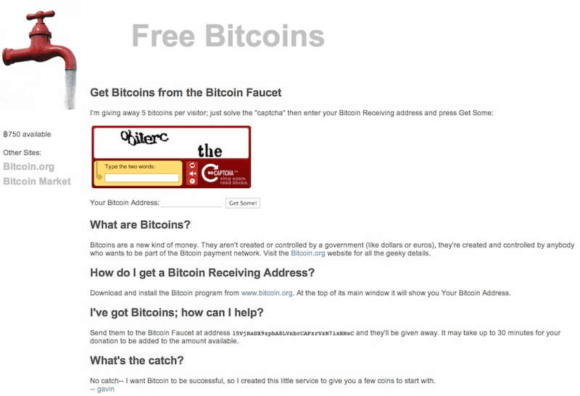
The first-ever Bitcoin faucet was created in 2010 by Gavin Andresen, one of Bitcoin’s earliest developers. At the time, Bitcoin was virtually unknown, and its value was negligible. Andresen’s faucet gave away 5 BTC per user, which was worth just a few cents then (but is worth tens of thousands of dollars today).
the-first-bitcoin-faucet

This groundbreaking initiative distributed over 19,700 BTC in total, sparking interest in Bitcoin and introducing thousands of people to cryptocurrency. It laid the foundation for the concept of Bitcoin faucets as a tool for education and adoption, a role they continue to play today.

Advantages of Using Bitcoin Faucets

Accessible Entry Point

One of the biggest advantages of Bitcoin faucets is their accessibility. Unlike buying Bitcoin on an exchange or mining it, which can require significant financial investment or technical expertise, faucets let you earn Bitcoin for free. All you need is an internet connection and a wallet to get started.

For beginners, this low barrier to entry makes faucets an ideal starting point to explore cryptocurrency. You don’t need to spend money or fully understand Bitcoin’s technical aspects right away. Faucets make Bitcoin approachable, helping people take their first steps into the crypto world with ease.

Educational Benefits

Bitcoin faucets also double as educational tools, offering a hands-on way to learn about cryptocurrency. They’re perfect for teaching the basics, such as:

  • Wallet Setup: How to create and secure a Bitcoin wallet.
  • Transactions: Understanding Bitcoin transfers, confirmations, and blockchain transparency.
  • Microtransactions: Gaining experience with sending and receiving small amounts of Bitcoin.

This practical exposure makes complex blockchain concepts easier to understand, especially for those new to digital currencies.

Earning Potential

While you won’t make a fortune from Bitcoin faucets, the earning potential is there. Modern faucets reward users based on the tasks they complete. On average:

  • Low Activity Users: Can earn around $0.02–$0.10 per session.
  • High Activity Users: With bonuses, referrals, or frequent use, earnings can reach $1–$3 per hour.

These small amounts might seem insignificant, but for many users, it’s not about the money—it’s about engaging with Bitcoin risk-free while earning a bit along the way.

Risk-Free Introduction

Faucets allow users to experience Bitcoin without any financial commitment, which is especially appealing in a volatile market. You can test the waters, learn how cryptocurrency works, and decide if you want to invest further—all without risking your own money.

For cautious beginners, this makes faucets a safe and practical way to gain confidence in using Bitcoin. Over time, these small experiences can lead to greater participation in the cryptocurrency ecosystem.

How Bitcoin Faucets Promote Adoption

Democratising Access

Bitcoin faucets play a vital role in making cryptocurrency accessible to everyone. Unlike traditional financial systems, where barriers like high transaction fees or complex account setups can exclude users, faucets eliminate these hurdles.

Anyone with an internet connection and a Bitcoin wallet can participate, regardless of their financial status or location. This inclusivity is especially impactful in regions with:

  • Limited access to banking services.
  • High costs associated with buying or mining Bitcoin.

By providing a way for people to earn Bitcoin without spending money, faucets empower individuals worldwide to engage with cryptocurrency.

Microtransactions Showcase

Faucets also highlight one of Bitcoin’s most practical applications: microtransactions. By distributing rewards as small as a few satoshis, faucets demonstrate how Bitcoin enables efficient, low-cost transfers of value.

This use case is particularly relevant as blockchain technology evolves, especially with tools like the Lightning Network, which enhances Bitcoin’s scalability for microtransactions. Faucets prove that Bitcoin isn’t just for large-scale transfers or investments—it’s also ideal for small, everyday transactions.

Community Building

Faucets foster a sense of community by encouraging experimentation and curiosity. They provide a safe environment for users to interact with Bitcoin, sparking interest among those who might not have otherwise engaged with cryptocurrency.

Historically, faucets have played a critical role in growing Bitcoin’s user base. The original faucet by Gavin Andresen distributed free Bitcoin, planting the seeds for the broader adoption we see today. Similarly, modern faucets:

  • Motivate users to explore Bitcoin further.
  • Encourage sharing and referral programs, which expand the network.

This community-driven approach aligns with the decentralised ethos of cryptocurrency, ensuring that participation remains open and inclusive.

Economic Aspects for Operators

Revenue Generation

For operators, Bitcoin faucets are more than just tools for promoting cryptocurrency—they’re a way to monetise web traffic. By integrating advertisements and affiliate marketing, faucet owners create revenue streams while distributing Bitcoin to users.

Here’s how it works:

  1. Advertising Revenue: Operators partner with advertisers to display banner ads, pop-ups, or videos on their platforms. The high traffic generated by faucets ensures steady ad impressions, translating to revenue.
  2. Affiliate Programs: Many faucets reward users for referring others. Operators benefit from affiliate deals that incentivise users to engage with specific products, services, or platforms.

Depending on traffic and user activity, faucet owners can earn anywhere from $100 to $1,000 per month. High-traffic faucets with engaged user bases may even surpass this range, especially if they optimise their monetisation strategies.

Sustainable Models

Running a faucet requires striking a delicate balance between rewarding users and managing operational costs. Key factors for sustainability include:

  • Reward Structure: Distributing rewards in satoshis ensures that even small payouts remain feasible without exhausting the faucet’s Bitcoin reserves.
  • Ad Optimisation: Choosing relevant, well-paying ads that don’t detract from the user experience helps operators maximise revenue.
  • User Engagement: Creating features like bonuses, referral programs, or gamified tasks encourages users to spend more time on the platform, increasing ad exposure.

Faucets with a sustainable model can maintain profitability while continuing to provide free Bitcoin, ensuring a win-win situation for both users and operators.

Challenges and Considerations

Declining Rewards

As Bitcoin’s popularity and value have grown, the rewards offered by faucets have significantly decreased. In the early days, faucets distributed whole Bitcoins to promote adoption. Today, due to higher demand and limited budgets, users earn only small fractions of Bitcoin, typically a few satoshis per task.

Factors contributing to declining rewards include:

  • Increased User Base: More users competing for the same pool of rewards.
  • Rising Bitcoin Value: As Bitcoin becomes more valuable, distributing even small amounts becomes costly for faucet operators.
  • Operating Costs: Higher costs for maintaining servers and distributing payments, which limit the budget for rewards.

While rewards remain modest, the educational and experiential benefits of faucets still make them worthwhile for beginners.

Security Concerns

Not all Bitcoin faucets are trustworthy. Scams and fraudulent sites have become a major issue, targeting users with promises of high rewards. These sites often aim to:

  • Steal Personal Information: By asking for unnecessary details like private keys or sensitive wallet info.
  • Install Malware: Infecting devices with harmful software to steal cryptocurrency or data.

Tips for Staying Safe:

  • Only use well-reviewed and reputable faucets.
  • Avoid faucets requiring personal details beyond your wallet address.
  • Use strong antivirus software to protect your device.

Time Investment

Bitcoin faucets require a significant time commitment relative to their financial returns. For most users, the small earnings (typically $0.02–$3 per hour) may not justify the effort. This is especially true when tasks become repetitive or when payout thresholds take a long time to reach.

Who Benefits Most?

  • Beginners: Faucets are ideal for learning without financial risk.
  • Casual Users: Those who don’t mind trading time for small rewards or exploring Bitcoin’s features in a low-pressure setting.

Ultimately, faucets are better suited for education and experimentation rather than as a primary method for earning Bitcoin.

Future of Bitcoin Faucets

Integration with Emerging Technologies

The future of Bitcoin faucets is closely tied to advancements in blockchain and cryptocurrency technology. One of the most promising developments is the Lightning Network, a layer-2 solution designed to improve Bitcoin’s scalability and transaction speed.

Faucets leveraging the Lightning Network could:

  • Enable Faster Transactions: Microtransactions could be nearly instant, eliminating delays associated with traditional Bitcoin transactions.
  • Reduce Fees: The Lightning Network significantly lowers transaction costs, making it more feasible for faucets to distribute even smaller rewards without being burdened by high fees.
  • Enhance User Experience: Faster and cheaper transactions would make faucets more attractive and accessible to a broader audience.

These upgrades could transform faucets into powerful tools for showcasing Bitcoin’s potential for everyday use, especially in microtransactions and low-cost transfers.

Evolving Educational Tools

As the cryptocurrency landscape grows more complex, Bitcoin faucets have the potential to evolve into robust educational platforms. They can adapt to teach users about emerging technologies like:

  • Decentralised Finance (DeFi): Faucets could introduce users to DeFi concepts by integrating tasks or tutorials focused on lending, staking, or yield farming.
  • NFTs and Tokenized Assets: Incorporating rewards in the form of NFTs or other digital assets could make faucets more engaging and diverse.
  • Privacy and Security: Faucets could educate users on advanced wallet security, privacy coins, and best practices for safeguarding their crypto.

These evolving features ensure faucets remain relevant, offering value beyond just earning Bitcoin. They can act as gateways for users to explore the broader cryptocurrency ecosystem.

Bitcoin faucets, while modest in rewards, are poised to remain vital in promoting Bitcoin adoption. By integrating emerging technologies and evolving with the crypto landscape, they can continue to educate, engage, and empower the next wave of cryptocurrency users.

Conclusion

Bitcoin faucets might seem simple on the surface, but they pack a powerful punch when it comes to promoting cryptocurrency adoption and education.

They offer a risk-free, accessible entry point for beginners curious about Bitcoin, allowing anyone to earn small amounts without spending money. Along the way, users gain hands-on experience with wallets, transactions, and the basic workings of blockchain technology. Faucets also highlight Bitcoin’s potential for microtransactions and contribute to the broader adoption of cryptocurrency by lowering barriers to participation.

While rewards are modest, the true value of Bitcoin faucets lies in their ability to educate, engage, and inspire curiosity about the decentralised financial future.

If you’re looking to take your first step into the world of Bitcoin, faucets are a great place to start. They’re not just about earning satoshis—they’re about learning, experimenting, and understanding how cryptocurrency can fit into your life.

Explore, experiment, and dive in—it all starts with a faucet.

FAQs

What is a Bitcoin faucet?

A Bitcoin faucet is a platform or website that rewards users with small amounts of Bitcoin (called satoshis) in exchange for completing simple tasks like solving captchas, watching ads, or filling out surveys.

How much can I earn from Bitcoin faucets?

Earnings vary depending on the faucet and your activity level. Modern faucets typically offer between $0.02 to $3 per hour, with higher earnings possible through bonuses, referrals, or frequent use.

Are Bitcoin faucets safe?

Most Bitcoin faucets are legitimate, but some are scams. To stay safe:

  • Use well-reviewed and reputable faucets.
  • Avoid sites that ask for personal information or private wallet keys.
  • Install antivirus software to protect against malware.

Do I need to invest money to use a Bitcoin faucet?

No, Bitcoin faucets don’t require any financial investment. Tasks are simple and free, making them accessible for anyone with an internet connection and a Bitcoin wallet.

Can Bitcoin faucets help me learn about cryptocurrency?

Absolutely. Bitcoin faucets provide practical, hands-on experience with:

  • Setting up and managing wallets.
  • Making transactions.
  • Understanding blockchain confirmations and Bitcoin’s basic functionality.

For beginners, they are a valuable educational tool to explore cryptocurrency risk-free.

Categories
Guides

Your Guide to Bitcoin Faucets: Free Crypto Rewards Made Simple

How Bitcoin Faucets Work: A Guide to Earning Free Bitcoin

Bitcoin faucets are online platforms or apps that reward users with small amounts of Bitcoin, called satoshis, in exchange for completing simple tasks. These tasks could be as straightforward as solving captchas, clicking ads, or filling out surveys. The term “faucet” comes from the idea of a dripping tap, offering small yet consistent amounts of Bitcoin over time.

Purpose and Significance

Bitcoin faucets play an essential role in the cryptocurrency ecosystem. They were created to spread awareness and adoption of Bitcoin by making it accessible to everyone, especially beginners. Here’s why they matter:

  1. Introduction to Bitcoin
    • Faucets serve as entry points for newcomers to explore Bitcoin without financial risk. By completing tasks and earning small amounts of cryptocurrency, users learn about wallet creation, transactions, and blockchain technology.
  2. Promoting Microtransactions
    • Faucets demonstrate the power of Bitcoin for microtransactions, showcasing its ability to handle low-value transfers efficiently. This highlights Bitcoin’s versatility beyond investment and trading.
  3. Educational Value
    • They teach users how to interact with cryptocurrencies in a hands-on way—key concepts like private key management and blockchain confirmations are introduced through real-world applications.
  4. Driving Decentralisation
    • Faucets align with the decentralised ethos of cryptocurrencies. They make Bitcoin distribution more inclusive, ensuring anyone can own a small piece of the digital asset, no matter their financial background.
  5. Gateway to Broader Ecosystem
    • Many Bitcoin faucet platforms integrate with other blockchain tools, like decentralised applications (dApps) and Lightning Network payments, offering users a glimpse into the broader cryptocurrency ecosystem.

For a comprehensive look at how Bitcoin faucets contribute to accessibility and education, don’t miss Benefits of Bitcoin Faucets: Promoting Accessibility and Adoption. This article dives deeper into the multifaceted advantages of faucets, from driving decentralization to showcasing microtransactions.

Key Things to Know

  • Origins: The first Bitcoin faucet, created by Gavin Andresen in 2010, gave away 5 BTC per user to promote adoption.
  • Tiny Payouts: Satoshis earned via faucets are often small, but over time, they add up.
  • Revenue Model: Faucets generate income through ads and sponsorships, redistributing a portion to users.
  • Accessibility: Faucets are free to use and require no upfront investment, making them a low-risk starting point for crypto exploration.
  • Educational Tool: They simplify complex cryptocurrency concepts, making Bitcoin more approachable for newcomers.

Bitcoin faucets are more than just free Bitcoin providers—they’re an accessible, educational gateway to the world of cryptocurrency. Their continued relevance highlights the importance of onboarding users into decentralised finance.

What Are Bitcoin Faucets?

Definition

Bitcoin faucets are websites or apps that give out small amounts of Bitcoin, called satoshis, as rewards for completing simple tasks. These tasks might include:

  • Solving captchas
  • Watching advertisements
  • Clicking on links
  • Answering surveys
  • Playing games

The rewards are micro-payments, designed to be accessible even for users who are completely new to Bitcoin.

How Do They Work?

  1. Users sign up and provide a Bitcoin wallet address.
  2. They complete small tasks to earn satoshis (fractions of Bitcoin).
  3. Earnings are stored in a micro wallet until they reach a minimum withdrawal limit.
  4. Once the limit is hit, users can transfer their Bitcoin to a main wallet.

The process highlights Bitcoin’s ability to handle microtransactions while giving users hands-on experience with the cryptocurrency ecosystem.

Origin of Bitcoin Faucets

Bitcoin faucets started as a way to promote adoption and education.

In 2010, Gavin Andresen, one of Bitcoin’s earliest developers, created the first-ever Bitcoin faucet.

the-first-bitcoin-faucet
  • It gave away 5 BTC per user—worth just pennies at the time.
  • The goal was to introduce people to Bitcoin by letting them experience transactions without buying Bitcoin first.
  • Andresen’s faucet distributed 19,700 BTC in total before running out of funds.

That’s now worth millions of dollars—a testament to Bitcoin’s growth since its early days.

Historical Context and Impact

Bitcoin faucets were crucial in:

  • Spreading awareness when Bitcoin was largely unknown.
  • Demonstrating utility by showing how Bitcoin transactions work.
  • Building trust in cryptocurrency by allowing people to test it for free.

Today, faucets serve a similar role, especially as entry points for newcomers exploring Bitcoin and decentralised finance.

For a broader overview of the origins, mechanisms, and impact of Bitcoin faucets, read Bitcoin Faucet Explained—How It Works and Why It Matters.

Key Takeaways

  • Bitcoin faucets distribute free Bitcoin to promote adoption and education.
  • The first faucet by Gavin Andresen gave away 5 BTC per user—a staggering amount in today’s terms.
  • Faucets remain relevant tools for learning about Bitcoin, microtransactions, and blockchain technology.

How Do Bitcoin Faucets Operate?

Bitcoin faucets run on a simple process designed to reward users with small amounts of Bitcoin, called satoshis, for completing basic online tasks.

User Registration Process

To get started, users typically:

  1. Sign Up: Register on the faucet platform with an email address.
  2. Provide a Bitcoin Wallet Address: Users enter a wallet address where rewards will eventually be sent.
  3. Create a Micro Wallet (Optional): Many faucets require a micro wallet to collect small payouts until they reach a minimum withdrawal amount.
  4. Verification (if needed): Some platforms use email confirmation or CAPTCHA tests to prevent bots.

No upfront payments are required, making faucets low-risk and highly accessible.

Types of Tasks Required

Earning Bitcoin from faucets involves completing quick, low-effort tasks, such as:

  • Solving CAPTCHAs: Prove you’re human by identifying letters, numbers, or images.
  • Clicking Ads: View ads and interact with promotional content.
  • Watching Videos: Short advertisements or tutorials related to crypto.
  • Answering Surveys: Provide feedback or opinions in exchange for rewards.
  • Playing Games: Mobile or web-based games that integrate faucet rewards.
  • Refer-a-Friend Programs: Earn commissions by referring new users.

Each task generates revenue for faucet operators through advertising fees, affiliate programs, or sponsorships, allowing them to share a portion of profits with users.

Reward System: Earning Satoshis

  • What Are Satoshis?
    • A satoshi is the smallest Bitcoin unit, equal to 0.00000001 BTC.
  • How Are Rewards Calculated?
    • Most faucets distribute 10–100 satoshis per task, depending on the task’s difficulty and time required.
  • Timers and Frequency:
    • Users may need to wait for a cooldown timer (e.g., 5 minutes) before claiming the next reward.
    • Some faucets offer hourly spins or bonus rewards for consecutive visits.

Role of Micro Wallets in Managing Payouts

Micro wallets are essential tools for faucet users because they:

  • Handle Small Transactions: Store tiny Bitcoin amounts without incurring large blockchain fees.
  • Aggregate Earnings: Collect rewards from multiple faucets in one place until the total reaches the payout threshold.
  • Automate Withdrawals: Transfer funds to a full Bitcoin wallet once the balance hits a set minimum (e.g., 10,000 satoshis).

Example Micro Wallet Providers:

  • FaucetPay – Popular for collecting faucet earnings.
  • CoinPot – Previously used for micro-payouts before closing in 2021.
  • ExpressCrypto – Supports multiple cryptocurrencies in addition to Bitcoin.

Micro wallets make faucets sustainable by solving the problem of high transaction fees for microtransactions.

Key Takeaways

  • Users register, complete simple tasks, and earn satoshis as rewards.
  • Tasks range from captchas and ads to games and surveys.
  • Rewards are collected in micro wallets to minimise fees and simplify withdrawals.
  • The faucet model is scalable and remains an effective way to introduce users to Bitcoin transactions and blockchain technology.

Economic Model Behind Bitcoin Faucets

Bitcoin faucets operate on a simple but effective revenue model that balances earning opportunities for users with profitability for operators. The system is fueled by advertising revenue, affiliate programs, and sponsorships, ensuring faucet platforms remain financially sustainable despite distributing free Bitcoin.

Revenue Generation for Faucet Operators

Bitcoin faucets don’t give away free cryptocurrency out of generosity. Instead, they generate revenue through:

  1. Advertising Revenue:
    • Faucets display ads from Google AdSense, media networks, and crypto ad platforms.
    • Users need to click ads, watch videos, or view pop-ups, which generates income for the faucet owner.
    • Example: High-traffic faucets can earn $1–$10 per 1,000 ad views depending on ad type.
  2. Affiliate Marketing:
    • Users are encouraged to invite others using referral links.
    • Faucets often pay 10–50% commissions on the earnings of referred users.
    • This creates viral growth, driving traffic and more ad revenue.
  3. Sponsorship Deals:
    • Some faucets partner with crypto wallets, exchanges, or mining platforms that pay for exposure.
    • Sponsored content and ads target crypto-curious users visiting these platforms.
  4. Premium Features:
    • Some faucets upsell additional services, like faster withdrawals or higher payouts, generating income directly from users.

Distribution of Earnings to Users

Faucet operators redistribute a portion of their earnings to users in the form of satoshis (fractions of Bitcoin). Here’s how it works:

  • Task Completion: Users perform actions like clicking ads or solving CAPTCHAs to earn points converted into satoshis.
  • Timers and Claim Limits: Faucets often impose a cooldown timer (e.g., 5–15 minutes) between claims to reduce overuse.
  • Daily Limits and Bonuses: Users may receive loyalty rewards or bonuses for visiting regularly.
  • Payout Thresholds: Earnings are stored in micro wallets until users accumulate enough satoshis for withdrawal.

Example Earnings Range:

  • 100–200 satoshis per claim on average.
  • High-paying faucets can offer up to 1,000 satoshis per claim during promotions.
  • Based on data from Coinmetro, faucet users can earn roughly $0.50–$3 per day, depending on activity.

Sustainability Challenges

While faucets were highly profitable in Bitcoin’s early days, sustainability has become a challenge as cryptocurrency values increased.

  1. Lower Rewards Due to Rising Bitcoin Prices:
    • Bitcoin’s value surged, making even small satoshis more expensive to give away.
    • Operators had to lower payouts to avoid losses, reducing user interest.
  2. Ad Revenue Dependency:
    • Revenue fluctuates with advertising rates and traffic volume.
    • Ad blockers further reduce click-based income, impacting faucet profitability.
  3. Fraud and Abuse:
    • Bots and multiple account fraud drain funds, forcing operators to introduce CAPTCHA systems and anti-spam tools.
    • Fraud prevention increases operational costs, cutting into profits.
  4. Transaction Fees and Withdrawals:
    • High Bitcoin transaction fees make micro-payments inefficient.
    • Faucets rely on micro wallets to group payouts, but fees still rise during network congestion.

Key Takeaways

  • Faucets earn money through ads, affiliates, and sponsorships while sharing a fraction of earnings with users.
  • Micro wallets play a critical role in managing payouts, reducing transaction costs.
  • Rising Bitcoin prices and fraudulent activity make faucet operations less profitable over time.
  • New technologies like the Lightning Network could help faucets process payments more efficiently in the future.

Technological Infrastructure of Bitcoin Faucets

Bitcoin faucets rely on efficient payment systems to handle microtransactions, ensuring users can claim small rewards without being affected by high transaction fees. The backbone of this infrastructure includes micro wallets and the Lightning Network, which streamline payments and make the faucet model sustainable.

Micro Wallets: Managing Small Payments

Micro wallets are specialised wallets designed to aggregate small payments before transferring them to a user’s primary Bitcoin wallet.

How They Work:

  • Collection Point: Micro wallets store multiple small transactions (satoshis) earned from faucets.
  • Threshold Limits: Users must reach a minimum balance (e.g., 10,000 satoshis) before transferring funds to their main wallet.
  • Low Transaction Fees: By batching withdrawals, micro wallets reduce the impact of blockchain fees, making tiny payouts viable.

Popular Micro Wallet Providers:

  1. FaucetPay: Supports multiple cryptocurrencies and enables quick payouts.
  2. ExpressCrypto: Previously popular, though it ceased operations in 2022.
  3. CoinPot: Offered combined balances but closed in 2021, reflecting the evolving landscape.

Benefits of Micro Wallets:

  • Efficiency: Prevents paying high transaction fees for small transfers.
  • Consolidation: Combines earnings from multiple faucets into one balance.
  • Automation: Simplifies withdrawals once thresholds are met.

Challenges with Micro Wallets:

  • Centralised Control: Some services require trust in third-party operators, reducing decentralisation.
  • Platform Shutdowns: Users risk losing funds if providers shut down without notice.

The Lightning Network: Boosting Microtransactions

The Lightning Network is a second-layer solution built on Bitcoin’s blockchain. It enables faster and cheaper transactions—a game-changer for faucets and micro-payments.

How It Works:

  • Creates off-chain payment channels between parties, allowing near-instant Bitcoin transfers.
  • Only the opening and closing transactions are recorded on the blockchain, reducing fees.

Benefits for Bitcoin Faucets:

  1. Lower Costs: Transactions are processed off-chain, cutting fees to fractions of a cent.
  2. Speed: Payments clear instantly, unlike regular Bitcoin transactions that can take 10–60 minutes for confirmation.
  3. Scalability: Handles thousands of transactions per second, making it ideal for high-volume platforms like faucets.
  4. Micropayment Support: Makes it profitable to send and receive tiny payments, overcoming Bitcoin’s earlier limitations.

Real-World Impact:

  • Faucets adopting the Lightning Network can now offer instant payouts, removing withdrawal delays.
  • Users avoid network congestion during periods of high blockchain activity, ensuring smooth earnings transfers.

Example Lightning Network Faucets:

  • Bitrefill Faucet: Offers Bitcoin micropayments directly through Lightning.
  • ZEBEDEE: Provides rewards for in-game Bitcoin earnings, leveraging Lightning’s instant transactions.

Key Takeaways

  • Micro wallets streamline Bitcoin faucets by bundling small payments, reducing fees and improving withdrawal efficiency.
  • The Lightning Network allows fast, low-cost microtransactions, making faucets scalable even in periods of high Bitcoin adoption.
  • Combined, these technologies modernise the faucet model, ensuring it remains relevant and profitable despite challenges like rising fees and network congestion.

Educational and Adoption Benefits of Bitcoin Faucets

Bitcoin faucets do more than just hand out free satoshis—they act as learning tools that introduce new users to the cryptocurrency world. By offering a risk-free entry point, faucets lower the barriers to understanding Bitcoin, blockchain technology, and digital payments.

Introducing New Users to Bitcoin

Bitcoin faucets serve as stepping stones for beginners who are curious about cryptocurrency but hesitant to invest their own money.

Key Benefits for New Users:

  • Risk-Free Exploration: Faucets provide small amounts of Bitcoin at no cost, allowing users to experiment without financial commitment.
  • Hands-On Experience: Users actively interact with wallets, transactions, and private keys, gaining practical knowledge.
  • Simplified Onboarding: Faucets break down complex cryptocurrency concepts into simple steps, making Bitcoin accessible to everyone.

Real-World Example:

Early faucets, such as Gavin Andresen’s first Bitcoin faucet, distributed 5 BTC per user in 2010 to boost adoption when Bitcoin was still unknown. This model proved effective, leading to wider public awareness of cryptocurrencies.

Teaching Wallet Creation and Transaction Processing

Bitcoin faucets walk users through critical processes like:

  • Creating a Wallet: Users set up either a micro wallet or a main wallet to store their earnings. This teaches them the importance of:
    • Private keys for security.
    • Seed phrases for backup and recovery.
  • Understanding Transactions: Faucets allow users to:
    • Track transactions on the blockchain using block explorers.
    • Learn how confirmations and fees impact payments.
    • Manage microtransactions effectively through batch payments.
  • Handling Withdrawals: Users experience real-time withdrawals, learning how to send and receive Bitcoin safely.

This step-by-step learning experience prepares users for more advanced interactions with cryptocurrency exchanges and decentralised finance (DeFi) platforms.

Contribution to Broader Cryptocurrency Adoption

Faucets do more than educate individuals—they play a key role in growing the cryptocurrency ecosystem.

Key Contributions:

  • Building Trust in Blockchain Technology: Faucets offer proof-of-concept demonstrations of how Bitcoin works, building confidence in its reliability.
  • Promoting Decentralisation: Users learn about Bitcoin’s role in eliminating intermediaries and enabling peer-to-peer payments.
  • Encouraging Participation in Crypto Markets: After gaining initial exposure through faucets, many users go on to buy, trade, and invest in cryptocurrencies.
  • Driving Innovation in Micropayments: Faucets highlight Bitcoin’s potential for handling microtransactions, paving the way for gaming rewards, loyalty programs, and dApp integrations.

Case Study:

According to a report by CoinDesk, faucets have played a role in onboarding millions of users into Bitcoin, especially in countries with limited access to traditional financial systems.

Key Takeaways

  • Bitcoin faucets provide a hands-on introduction to cryptocurrency for beginners.
  • Users learn about wallet creation, transactions, and security in a practical environment.
  • Faucets act as entry points into the larger crypto world, encouraging participation and investment.
  • They help promote mass adoption by breaking down barriers to entry and offering risk-free exposure.

Case Studies and Statistics on Bitcoin Faucets

Bitcoin faucets have evolved significantly since their inception, offering insights into user engagement, payout structures, and the broader adoption of cryptocurrency. Below are key case studies and statistics that shed light on how faucets have operated over the years and their current state in 2024.

Average Payouts in 2024

Modern Bitcoin Faucets:

  • In 2024, the average faucet pays users a few cents to a couple of dollars per hour, depending on platform traffic and the value of Bitcoin.
  • Low-Reward Faucets: Users typically earn 100–200 satoshis per task (equivalent to $0.02–$0.05 per task at a Bitcoin price of $25,000).
  • High-Reward Faucets: Some faucets offer bonus spins or referral incentives, pushing earnings closer to $1–$3 per hour for highly active users.

Factors Affecting Earnings:

  1. Bitcoin Price Volatility: Rising Bitcoin prices reduce the amount of satoshis distributed.
  2. Task Complexity: Faucets requiring surveys or app downloads may offer higher payouts.
  3. Traffic Volume: Platforms with more users often dilute individual rewards to maintain sustainability.
  4. Historical Impact: Early Faucets Distributing Whole Bitcoins

The First Bitcoin Faucet (2010):

  • Created by Gavin Andresen, the first faucet distributed 5 BTC per user to encourage Bitcoin adoption.
  • At the time, Bitcoin’s value was less than $1, so the giveaways seemed insignificant.

Impact:

  • Over its lifetime, the faucet gave away 19,700 BTC, valued at over $500 million today.
  • It introduced thousands of users to Bitcoin, many of whom became long-term crypto enthusiasts or investors.

Other Early Faucets:

  • During Bitcoin’s early years (2010–2013), many faucets offered 0.1–1 BTC per claim, as transaction fees were negligible.
  • These faucets played a key role in onboarding users who later helped drive Bitcoin’s adoption.

Evolution of User Engagement Over Time

Bitcoin faucets have transformed significantly to adapt to technological and market changes:

2010–2013: The Generous Era

  • High payouts (whole Bitcoins) were common due to low transaction fees and Bitcoin’s minimal market value.
  • Engagement was driven by curiosity about this new digital currency.

2014–2018: Consolidation and Popularity

  • Faucets started focusing on ads and affiliate programs for revenue.
  • Payouts shifted to fractions of Bitcoin, reflecting rising market value.
  • Platforms introduced gamification elements like bonus spins and loyalty rewards to retain users.

2019–2024: Scalability and Adaptation

  • Adoption of micro wallets and the Lightning Network to handle payouts efficiently.
  • Lower payouts due to Bitcoin’s rising value but increased focus on user engagement through surveys, games, and referrals.
  • Faucets diversified, offering multi-crypto payouts to attract a broader audience.

Key Takeaways

  • Earnings Today: Users earn between $0.50–$3 per hour depending on activity level and platform.
  • Historical Generosity: Early faucets like Gavin Andresen’s distributed entire Bitcoins, playing a pivotal role in Bitcoin’s adoption.
  • Evolving Engagement: Faucets have shifted from simple giveaways to more interactive platforms using gamification and ad-based models.

Bitcoin faucets remain relevant as educational tools and onboarding platforms for cryptocurrency, though their economic model has adapted to changing times.

Challenges and Criticisms of Bitcoin Faucets

While Bitcoin faucets have played a significant role in promoting cryptocurrency adoption, they face several challenges that affect their long-term sustainability. From fraud and abuse to declining rewards and user experience issues, faucets must constantly adapt to remain viable.

Fraud and Abuse (Bots and Exploits)

One of the biggest challenges for Bitcoin faucets is fraudulent activity, including:

  • Bot Attacks:
    • Automated programs are often used to repeatedly claim rewards, draining faucet funds quickly and unfairly.
  • Impact:
    • Operators lose revenue and legitimate users receive lower payouts.
  • Multiple Accounts (Sybil Attacks):
    • Users create multiple identities to bypass claim limits and cooldown timers.
  • CAPTCHA Solvers:
    • Fraudsters use automated tools to solve captchas, making it harder for faucets to identify genuine users.
  • IP Address Manipulation:
    • Proxy servers and VPNs are used to bypass IP restrictions, allowing repeated claims.

Countermeasures:

  • Most faucets now require email verification, CAPTCHAs, and IP tracking to prevent abuse.
  • Advanced platforms leverage machine learning algorithms to detect suspicious activity.

Despite these efforts, fraud prevention increases operational costs, impacting faucet profitability.

Declining Rewards Due to Rising Bitcoin Value

Bitcoin’s value has skyrocketed since faucets were first introduced. In 2010, 5 BTC giveaways were worth less than $1. Today, 5 BTC is worth over $200,000, making such payouts unsustainable.

Impact on Earnings:

  • Most faucets now pay only 100–200 satoshis per claim (about $0.02–$0.05), leaving users frustrated with low rewards.
  • Users need to spend hours clicking ads or completing tasks to earn even $1–$3 per day.
  • Faucets have had to reduce payouts further during Bitcoin bull runs, as maintaining high rewards became impossible.

Key Stats (2024):

  • Average faucet earnings: $0.50–$3 per hour based on activity level.
  • Minimum withdrawal thresholds: 10,000–50,000 satoshis, which may take weeks to achieve depending on payouts.

Solutions Being Tested:

  • Integrating the Lightning Network to reduce transaction fees, enabling faster and cheaper payouts.
  • Exploring multi-crypto faucets offering tokens like Dogecoin and Litecoin, which are more affordable for microtransactions.

User Experience Concerns

Many faucets have shifted their focus toward ads and affiliate programs, sometimes at the expense of user experience.

Common Complaints:

  • Intrusive Ads:
    • Pop-ups, redirects, and auto-play videos frustrate users and create a spammy experience.
  • Lengthy Payout Processes:
    • Users often have to wait weeks or months to reach the minimum payout amount.
  • Hidden Fees:
    • Some faucets charge withdrawal fees, further reducing actual earnings.
  • Trust Issues:
    • Many faucets shut down unexpectedly, leaving users unable to withdraw funds.
    • Users are often sceptical of new faucets due to scams and rug pulls.

Improvements Needed:

  • Better user interface designs to simplify navigation.
  • Transparent payout systems to build trust.
  • Improved mobile compatibility, as more users access faucets via smartphones.

Key Takeaways

  • Fraud and Abuse: Bots, VPNs, and CAPTCHA solvers make faucet management expensive and complex.
  • Lower Rewards: Rising Bitcoin values have drastically reduced payouts, limiting user earnings.
  • Poor User Experience: Ad-heavy platforms and long payout delays lead to user dissatisfaction.

Future Outlook:

Bitcoin faucets need to evolve by:

  • Leveraging technologies like the Lightning Network to reduce costs.
  • Offering multi-crypto rewards to sustain higher payouts.
  • Improving security systems to block fraudulent activity and enhancing user experiences for better retention.

Future Prospects of Bitcoin Faucets

Bitcoin faucets continue to evolve as technology advances and cryptocurrency adoption grows. While traditional faucet models face challenges, new opportunities have emerged through decentralised applications (dApps), blockchain innovations, and layer-2 solutions like the Lightning Network. These advancements are helping faucets stay relevant in the ever-changing crypto landscape.

Adaptation to New Technologies and Platforms

Bitcoin faucets are embracing modern technologies to improve efficiency and user experience:

  • Lightning Network Integration:
    • Faucets are adopting the Lightning Network to handle instant micropayments with lower fees.
    • This allows faucets to offer faster withdrawals and higher payouts, addressing one of their biggest challenges—transaction costs.
  • Mobile and Web3 Applications:
    • Faucets are moving to mobile-friendly platforms and integrating with Web3 wallets to simplify access.
      • Example: Some faucets now allow users to connect their MetaMask wallets or scan QR codes for payments, enabling a seamless experience.
  • Gamification and Rewards Systems:
    • Modern faucets incorporate games, quizzes, and challenges to keep users engaged.
    • Platforms like ZEBEDEE even offer Bitcoin rewards for in-game actions, blurring the line between gaming and earning.
  • Multi-Crypto Support:
    • Many faucets now distribute multiple cryptocurrencies, catering to the growing interest in altcoins and tokenised assets like Ethereum and Dogecoin.

Integration with Decentralised Applications (dApps)

Decentralised applications (dApps) offer exciting opportunities for Bitcoin faucets to grow beyond their current use cases:

  • Smart Contract Faucets:
    • Faucets can be built directly on Ethereum, Polygon, or other blockchain networks using smart contracts to automate payouts and improve transparency.
  • dApp Partnerships:
    • Faucets can integrate with DeFi platforms and NFT marketplaces, allowing users to earn Bitcoin rewards while interacting with decentralised finance tools or purchasing NFTs.
  • Token Rewards and Staking Incentives:
    • Faucets may evolve to include staking programs, where users lock up cryptocurrency to earn additional rewards, combining faucets with yield farming concepts.
  • Micropayment Infrastructure for dApps:
    • Faucets could power microtransactions within dApps, enabling payments for content, services, or gaming rewards without traditional payment systems.

Ongoing Relevance in the Cryptocurrency Landscape

Despite challenges, Bitcoin faucets remain relevant as:

  • Educational Tools:
    • Faucets continue to provide hands-on training for new users, teaching them about wallets, transactions, and blockchain security.
  • Low-Risk Entry Points:
    • Faucets allow curious users to experiment with cryptocurrencies without the risk of losing money.
  • Marketing Channels:
    • Cryptocurrency companies use faucets as advertising platforms to promote their products, services, and tokens.
  • Scaling Opportunities with Layer-2 Solutions:
    • Technologies like the Lightning Network make faucets more sustainable by reducing fees and speeding up payments, keeping faucets practical even with small payouts.
  • Web3 and Metaverse Integration:
    • Faucets could be integrated into metaverse platforms, offering users rewards for virtual activities, enhancing engagement in virtual economies.

Key Takeaways

  • Bitcoin faucets are adapting to modern technologies like the Lightning Network and Web3 wallets to improve scalability and efficiency.
  • Integrations with decentralised applications (dApps) could expand their functionality, merging them with DeFi tools and gaming platforms.
  • Faucets remain relevant by acting as educational tools, marketing platforms, and gateways to broader cryptocurrency adoption.
  • As the crypto ecosystem evolves, faucets will likely become part of larger decentralised infrastructures, enabling microtransactions and rewards systems in the digital economy.

Conclusion: The Role and Impact of Bitcoin Faucets

Bitcoin faucets have played a pivotal role in introducing millions of people to the cryptocurrency world. Starting as simple giveaways of whole Bitcoins in 2010, faucets have evolved into interactive platforms that educate users, promote blockchain adoption, and demonstrate the potential of microtransactions.

They’ve proven to be:

  • Educational Tools: Teaching users about wallets, transactions, and blockchain security without financial risks.
  • Onboarding Platforms: Lowering barriers to entry for newcomers, making cryptocurrency more accessible.
  • Marketing Channels: Offering businesses a way to reach crypto-savvy audiences through ads and referrals.
  • Proof-of-Concept Systems: Highlighting Bitcoin’s ability to handle micropayments efficiently.

Final Thoughts on Their Significance in the Digital Economy

Bitcoin faucets continue to adapt as cryptocurrency technologies advance. With innovations like the Lightning Network and Web3 integrations, faucets remain relevant tools for educating users and enabling low-cost transactions.

Looking ahead:

  • Faucets are likely to become part of decentralised applications (dApps) and gaming ecosystems, offering rewards through blockchain-powered platforms.
  • They will maintain their role as entry points for crypto adoption, providing low-risk learning environments for beginners.
  • As digital economies expand, faucets could support micropayment systems and tokenised incentives, reinforcing Bitcoin’s value beyond speculation and trading.

While individual faucet platforms may come and go, the core concept of using microtransactions to engage users and promote adoption will continue to influence the cryptocurrency ecosystem.

Categories
Guides

Bitcoin Faucets Explained: How They Work and Why It Matters

Bitcoin Faucets Explained: How They Work and Why It Matters

Bitcoin Faucets Explained: Introduction

What Is a Bitcoin Faucet?

A Bitcoin faucet is a platform or tool that distributes small amounts of Bitcoin to users as rewards for completing simple tasks. These tasks may include solving captchas, watching ads, clicking links, or playing mini-games. Faucets were created as a way to promote Bitcoin adoption by allowing people to interact with cryptocurrency without the need for initial investment.

Think of Bitcoin faucets as free samples of Bitcoin, designed to get users comfortable with using digital wallets and making transactions. They also highlight how microtransactions work on the Bitcoin network, providing hands-on experience with cryptocurrency.

Purpose of Bitcoin Faucets

  • Promote Bitcoin Adoption – Faucets introduce Bitcoin to beginners by providing free tokens to experiment with. Users can learn to set up wallets, send and receive Bitcoin, and experience blockchain transactions firsthand.
  • Hands-On Learning Tool – They make Bitcoin approachable by removing the financial risk. Users gain confidence in managing cryptocurrency while earning small amounts.
  • Demonstrate Bitcoin Technology – Faucets showcase Bitcoin’s ability to handle microtransactions, reinforcing its practical applications in real-world scenarios.

Why Do Bitcoin Faucets Still Matter?

Despite Bitcoin’s growth and increased value, faucets remain relevant for several reasons:

  1. Educational Resource
    • Help beginners understand how Bitcoin works—from setting up wallets to making transactions.
    • Provide real-world exposure to blockchain concepts without requiring a financial commitment.
  2. Passive Income Potential
    • Offer small but steady earnings through tasks, making them attractive for users exploring passive income streams.
    • Referral programs often provide bonuses for bringing in new users, amplifying earnings.
  3. Microtransaction Demonstration
    • Highlight Bitcoin’s efficiency in handling tiny payments.
    • Encourage exploration of technologies like the Lightning Network, which optimises Bitcoin’s scalability for microtransactions.

For a more detailed exploration of why Bitcoin faucets continue to be valuable tools for education, accessibility, and adoption, check out Benefits of Bitcoin Faucets: Promoting Accessibility and Adoption. This article dives into how faucets empower users by offering a risk-free entry into cryptocurrency while showcasing Bitcoin’s practical applications in microtransactions.

Key Things to Know About Bitcoin Faucets

  • Risk-Free Entry Point – Perfect for newcomers to cryptocurrency who want to learn without investing money.
  • Simple Tasks, Real Rewards – Users complete easy actions to earn satoshis, the smallest unit of Bitcoin.
  • Ad-Supported Model – Faucets sustain themselves through advertising revenue, distributing a portion as rewards.
  • Wallet Integration – Most faucets require users to connect a Bitcoin wallet to receive payouts, reinforcing wallet setup practices.
  • Low Payouts, High Learning Value – While rewards are small, the experience gained is often more valuable than the earnings themselves.

Stay tuned as we explore how Bitcoin faucets work, their history, and the types available in the following sections!

The History of Bitcoin Faucets

Early Days (2010)

Bitcoin faucets trace their origins back to 2010, just one year after Bitcoin’s launch.

the-first-bitcoin-faucet
  • Invented by Gavin Andresen – A key developer in Bitcoin’s early growth.
  • First Faucet Payouts – Distributed 5 BTC per claim (worth only a few cents at the time).
  • Purpose – Designed to encourage people to explore and experiment with Bitcoin by giving them free coins.

At the time, Bitcoin was an experimental concept with almost no mainstream adoption. Faucets served as a tool to spread awareness, educate users, and get more people to set up Bitcoin wallets.

Why Were Bitcoin Faucets Created?

Bitcoin faucets were designed to solve two early challenges in cryptocurrency adoption:

  1. Encouraging Experimentation
    • Faucets gave people a way to try out blockchain technology without the fear of losing money.
    • Users could practice sending and receiving Bitcoin, helping them understand wallet management.
  2. Demonstrating Decentralisation
    • Faucets highlighted Bitcoin’s ability to process peer-to-peer payments without middlemen.
    • They showed that small transactions could be sent anywhere in the world quickly and cheaply.
  3. Driving Adoption
    • Distributing free Bitcoin helped generate buzz and build a user base when interest was low.
    • Faucets allowed everyday people to experience owning cryptocurrency.

Evolution Over Time

As Bitcoin grew in value, the faucet model needed to adapt to keep up with market changes:

  1. Payout Adjustments
    • Early faucets gave away whole Bitcoins.
    • As Bitcoin’s price surged, rewards shifted to satoshis (fractions of Bitcoin).
  2. Ad-Supported Revenue Models
    • Faucets began relying on advertisements to fund payouts.
    • Users earned Bitcoin while interacting with ads, surveys, and games—turning faucets into a micro-task economy.
  3. Technological Upgrades
    • Modern faucets now integrate with the Lightning Network to handle faster, cheaper microtransactions.
    • This allows faucets to process payouts almost instantly while reducing transaction fees.
  4. Diversification
    • Today’s faucets aren’t limited to Bitcoin. Many support multiple cryptocurrencies, expanding options for users and broadening their appeal.

Key Takeaways

  • Bitcoin Faucets Started Small: They distributed entire Bitcoins to get people interested in crypto.
  • Adapting to Growth: Over time, faucets evolved from simple giveaways to ad-driven platforms offering micro-earnings.
  • Tech-Enabled Scalability: With tools like the Lightning Network, faucets continue to operate efficiently, even as Bitcoin’s value rises.
  • Evergreen Purpose: While payouts are smaller today, faucets remain a gateway for education and adoption, proving their long-term value.

How Bitcoin Faucets Work

Step-by-Step Process

1. Sign Up

  • Users create an account on a Bitcoin faucet website or app.
  • A Bitcoin wallet address is required to receive rewards.
  • Some faucets allow quick access without registration, but accounts are usually required for larger payouts and referrals.

2. Complete Tasks

  • Faucets reward users for engaging in small activities such as:
    • Solving captchas – Prove you’re human to prevent bots.
    • Watching ads or videos – View sponsored content for payouts.
    • Playing games – Earn rewards by reaching milestones or achieving scores.
    • Taking surveys – Share opinions and data for payouts.
    • Spinning wheels or lottery systems – Introduce randomness and gamification for engagement.

3. Claim Rewards

  • After completing tasks, users earn small amounts of Bitcoin called satoshis (fractions of a Bitcoin).
  • Claims may be allowed every few minutes or at set intervals, depending on the faucet.

4. Withdraw Earnings

  • Users can withdraw their earnings after reaching a minimum payout threshold, which varies by platform.
  • Funds are transferred to the connected Bitcoin wallet, either manually or automatically.
  • Some faucets support Lightning Network withdrawals, allowing faster and cheaper transactions.

For a deeper breakdown of the process and its practical applications, check out our comprehensive guide—How Bitcoin Faucets Work: A Guide to Earning Free Bitcoin.

Revenue Model

How Do Faucets Make Money?

Bitcoin faucets are ad-driven platforms designed to generate revenue while distributing rewards:

  • Advertising Revenue
    • Faucets display banner ads, video ads, and pop-ups to generate income.
    • Users interact with ads during tasks, which creates earnings for the faucet owner.
  • Affiliate Marketing
    • Many faucets promote affiliate offers or referral programs.
    • Users can earn bonuses by inviting others, helping faucets grow their audience.
  • Partnership Deals
    • Faucets may partner with cryptocurrency exchanges or wallet providers, earning commissions for referrals.
  • Premium Memberships
    • Some faucets offer paid tiers for higher payouts or exclusive tasks, creating an additional revenue stream.

This business model allows faucets to operate without requiring upfront payments from users while maintaining profitability.

Key Terms to Know

  • Satoshi
    • The smallest unit of Bitcoin, equal to 0.00000001 BTC.
    • Named after Satoshi Nakamoto, Bitcoin’s anonymous creator.
  • Wallet
    • A digital storage tool for holding Bitcoin securely.
    • Wallets come in different forms: software wallets (apps), hardware wallets (physical devices), and online wallets.
  • Microtransactions
    • Small-scale payments often used in online platforms, gaming, and faucets.
    • Enabled by Bitcoin’s divisibility and scalability features, especially through the Lightning Network.

Key Takeaways

  • No Investment Required: Bitcoin faucets are free to use, making them accessible to anyone with a smartphone or computer.
  • Low Payouts, Consistent Earnings: Users earn in small increments, but combining tasks and referrals can lead to steady accumulation over time.
  • Ad-Based Revenue Model: Faucets sustain payouts by monetising traffic through ads, affiliates, and premium features.
  • Built for Microtransactions: Faucets highlight Bitcoin’s ability to handle low-cost, small payments, demonstrating its real-world usability.

Types of Bitcoin Faucets

Bitcoin faucets have evolved to cater to different user preferences, offering a variety of ways to earn Bitcoin and even other cryptocurrencies. Here’s a breakdown of the most common types:

Standard Faucets

freebitco.in bitcoin faucet-site
  • How They Work – Users earn rewards by completing simple tasks like:
    • Solving captchas to prove they’re human.
    • Clicking ads or visiting sponsored websites.
    • Watching short promotional videos.
  • Best For – Beginners looking to earn their first Bitcoin without much effort.
  • Key Feature – Regular claims with cooldown timers (e.g., every 5–15 minutes).

Game-Based Faucets

satoshi hero bitcoin casino games
  • How They Work – Users earn Bitcoin by playing mini-games or achieving milestones in challenges.
  • Examples of Tasks
    • Spin-the-Wheel Games – Luck-based payouts.
    • Puzzle Challenges – Solve puzzles to unlock rewards.
    • Role-Playing Games (RPGs) – Complete levels or missions for payouts.
  • Best For – Gamers who want to combine fun with earning Bitcoin.
  • Key Feature – Engagement-focused platforms with addictive tasks.

Survey Faucets

Cointiplu Bitcoin Rewards
  • How They Work – Users earn Bitcoin by completing surveys and submitting feedback.
  • Examples of Tasks
    • Product reviews.
    • User experience surveys.
    • Market research questionnaires.
  • Best For – Users comfortable sharing opinions and demographic data.
  • Key Feature – Higher payouts compared to other faucets but takes more time per task.

Referral Faucets

highest-paying-crypto-bitcoin-faucet
  • How They Work – Users earn bonuses by inviting new members to the platform.
  • Examples of Earnings
    • Fixed bonuses when referrals sign up.
    • Ongoing commissions based on referral earnings.
  • Best For – Users with strong social networks or marketing skills.
  • Key Feature – Passive income potential through long-term referral earnings.

Multi-Coin Faucets

firefaucet-auto-faucet
  • How They Work – Platforms that distribute not just Bitcoin, but also other cryptocurrencies like:
    • Ethereum (ETH)
    • Litecoin (LTC)
    • Dogecoin (DOGE)
    • Ripple (XRP)
  • Best For – Users interested in building a diverse cryptocurrency portfolio.
  • Key Feature – Flexible earning options across multiple coins.

Key Takeaways

  • Diverse Earning Methods – From simple captchas to fun games and surveys, faucets cater to different user interests.
  • Referral Bonuses Boost Income – Users can multiply earnings through referral programs, making them ideal for those with strong networks.
  • Multi-Coin Options Expand Portfolios – Faucets offering multiple cryptocurrencies allow users to experiment beyond Bitcoin.
  • Entertainment + Earnings – Game-based faucets make earning Bitcoin enjoyable, while surveys offer higher payouts for more effort.

Benefits of Using Bitcoin Faucets

Bitcoin faucets offer several advantages that make them appealing to both beginners and experienced cryptocurrency enthusiasts. Whether you’re exploring Bitcoin for the first time or looking for ways to earn small, consistent rewards, faucets provide value in multiple ways.

Free Bitcoin Access

  • No Investment Required – Faucets provide a completely risk-free way to acquire Bitcoin.
  • Accessibility for Everyone – Users only need an internet connection and a Bitcoin wallet—no purchases or deposits are necessary.
  • Exposure to Bitcoin – Faucets give beginners the chance to own Bitcoin, even if they’re hesitant to invest their own money.

Key Takeaway: Faucets break down financial barriers, allowing anyone to start earning Bitcoin immediately.

Hands-On Learning

  • Practical Experience – Users learn how to create wallets, receive payments, and transfer Bitcoin.
  • Blockchain Familiarity – Faucets act as interactive tutorials, showing users how transactions are recorded on the blockchain.
  • Confidence Building – Beginners can experiment without the fear of making costly mistakes.

Key Takeaway: Faucets act as an educational sandbox for those new to cryptocurrency.

Low-Risk Introduction to Crypto

  • No Financial Loss – Users earn Bitcoin instead of risking their own funds, making faucets ideal for cautious learners.
  • Testing Ground for Strategies – Users can experiment with crypto storage, trading, and transfers before committing larger investments.
  • Learning Tool for Market Trends – Faucets help users follow market price movements and understand how Bitcoin value fluctuates.

Key Takeaway: Faucets remove the fear of loss, encouraging participation in cryptocurrency markets.

Decentralisation Showcase

  • Peer-to-Peer Payments – Faucets highlight how Bitcoin enables direct, trustless transactions without banks or intermediaries.
  • Real-World Applications – Users experience firsthand how Bitcoin operates as digital cash, reinforcing its potential for global payments.
  • Microtransaction Utility – Faucets demonstrate the practicality of small payments, especially with technologies like the Lightning Network.

Key Takeaway: Faucets showcase Bitcoin’s core philosophy of decentralisation and global accessibility.

Passive Income Potential

  • Steady Earnings Over Time – While rewards are small, consistent usage and referrals can lead to long-term accumulation.
  • Referral Programs Multiply Income – Inviting new users boosts earnings, turning faucets into a low-effort passive income stream.
  • Gamified Earning – Game-based faucets make earning Bitcoin fun and engaging, keeping users motivated to return.

Key Takeaway: Faucets provide a gateway to passive income, especially for users who actively promote referral programs.

Key Benefits Recap

  • Free and Accessible – Faucets make Bitcoin ownership possible without any financial commitment.
  • Educational Tool – Hands-on learning helps users grasp crypto fundamentals safely.
  • Risk-Free Crypto Exposure – Faucets build confidence without requiring an initial investment.
  • Decentralization in Action – Users see Bitcoin’s potential for peer-to-peer payments and microtransactions.
  • Passive Income Streams – Referrals and consistent participation lead to cumulative earnings.

Challenges and Risks of Bitcoin Faucets

While Bitcoin faucets offer free access to cryptocurrency and educational opportunities, they also come with several challenges and risks that users need to be aware of. Here’s a breakdown of the key issues:

Legitimacy Issues

  • Scams and Fraudulent Faucets – Many faucets promise payouts but never actually send rewards.
  • Phishing Attacks – Some malicious sites attempt to steal wallet information or personal data.
  • Hidden Fees or Malware – Certain faucets may require software downloads, potentially exposing users to malware or viruses.

How to Avoid Scams:

  • Verify Trustworthiness – Stick to reputable platforms with positive reviews and high user ratings.
  • Use Secure Wallets – Only connect faucets to wallets designed for microtransactions, avoiding large balances in linked accounts.
  • No Downloads Required – Avoid any faucet that asks for software downloads.

Key Takeaway: Always research faucet platforms thoroughly before signing up to ensure legitimacy and security.

Low Payouts

  • Minimal Rewards – Faucets distribute tiny fractions of Bitcoin (satoshis), often requiring extended participation to see meaningful earnings.
  • Patience Required – Building up enough Bitcoin to make a withdrawal may take days, weeks, or even months.
  • Time-Consuming – Tasks can be repetitive, and earnings often don’t justify the effort for users looking for quick income.

How to Maximise Earnings:

  • Focus on faucets with referral programs to boost earnings passively.
  • Combine multiple faucets for higher cumulative payouts.
  • Prioritise platforms with low withdrawal thresholds to cash out faster.

Key Takeaway: Faucets aren’t designed to make users rich—they’re more about learning and earning small amounts over time.

Ad-Dependence

  • Revenue-Based Model – Faucets rely heavily on advertising revenue to fund payouts.
  • Sustainability Risks – If ad revenue drops, faucet operators may reduce payouts or shut down entirely.
  • User Experience Issues – Excessive ads, pop-ups, and redirects can make faucets frustrating to use.

How to Handle Ad Overload:

  • Use a dedicated browser or device to keep faucet activities separate from personal browsing.
  • Prioritise faucets with clean interfaces and limited ad interruptions.
  • Consider premium memberships on platforms that reduce ads in exchange for fees (if the earnings justify it).

Key Takeaway: Faucets are dependent on ad revenue, which may affect payout reliability and overall user experience.

Withdrawal Thresholds

  • High Minimum Payouts – Many faucets require users to accumulate a certain balance before allowing withdrawals, often delaying access to funds.
  • Inactive Accounts – Some faucets reset balances if accounts remain inactive, causing users to lose earnings.
  • Hidden Fees – Withdrawal processing fees may further reduce payouts.

How to Avoid Withdrawal Issues:

  • Look for faucets with low payout thresholds and automatic withdrawal options.
  • Stay active on platforms to avoid balance resets.
  • Read terms and conditions carefully before investing time into a faucet.

Key Takeaway: Always check payout policies in advance to avoid frustration and lost earnings.

Key Challenges Recap

  1. Legitimacy Risks – Fraudulent faucets and phishing attempts can compromise security.
  2. Low Earnings – Payouts are small, making faucets unsuitable for those seeking quick profits.
  3. Ad Dependency – Faucets rely on ad revenue, which affects sustainability and user experience.
  4. Withdrawal Limits – High thresholds and fees can make accessing earnings time-consuming.

Final Thoughts on Challenges and Risks

While Bitcoin faucets remain valuable tools for learning and experimenting, they come with limitations that users need to approach with realistic expectations. By sticking to trusted platforms, leveraging referral programs, and managing expectations about earnings, users can minimise risks and make the most out of faucets.

Modern Adaptations and Technology

Bitcoin faucets have evolved significantly since their inception, adapting to new technologies and market demands to stay relevant. These advancements make faucets more efficient, scalable, and versatile than ever before. Here’s how modern faucets have adapted:

Lightning Network Integration

The Lightning Network is one of the most transformative upgrades for Bitcoin faucets.

  • Faster Transactions – Payments process almost instantly, solving the delays associated with Bitcoin’s main blockchain.
  • Lower Fees – Microtransactions are now cost-effective, making faucets sustainable even with small payouts.
  • Scalability – Faucets can handle higher traffic without bottlenecks, supporting thousands of users simultaneously.
  • User Benefits – Users can claim and withdraw rewards more frequently without worrying about high fees or wait times.

Example Use Case: A faucet using the Lightning Network can allow instant withdrawals to wallets supporting the protocol, eliminating long wait periods.

Key Takeaway: Faucets leverage the Lightning Network to handle microtransactions quickly and cheaply, keeping them relevant in a fast-moving crypto economy.

Automated Systems

Modern faucets now use automation to streamline operations and improve user experience:

  • Seamless Claims – Users can set up auto-claims to collect rewards without manual input.
  • Scheduled Payouts – Earnings are automatically sent to wallets once minimum thresholds are met.
  • Fraud Prevention – Automated systems detect and block bots or suspicious activity, ensuring legitimate users receive payouts.
  • Improved Security – Two-factor authentication (2FA) and wallet encryption features are now standard.

Example Use Case: Faucets with auto-claim features allow users to earn rewards while multitasking, increasing efficiency.

Key Takeaway: Automation has made faucets faster, safer, and easier to use, removing manual processes and reducing fraud.

Multi-Coin Support

Modern faucets are no longer limited to Bitcoin—they now support multiple cryptocurrencies:

  • Diversified Options – Popular coins supported include:
    • Ethereum (ETH) – Smart contract compatibility.
    • Litecoin (LTC) – Faster and cheaper transactions.
    • Dogecoin (DOGE) – Known for meme culture and low fees.
    • Ripple (XRP) – Focused on cross-border payments.
  • Portfolio Growth – Users can earn and experiment with multiple coins, diversifying their holdings.
  • User Choice – Faucets let users switch between cryptocurrencies, depending on payout rates and market trends.
  • Scalability – Supporting multiple coins helps faucets reach wider audiences, attracting users interested in various cryptocurrencies.

Example Use Case: A faucet offering Ethereum rewards alongside Bitcoin appeals to users exploring decentralised finance (DeFi) ecosystems.

Key Takeaway: Multi-coin support keeps faucets aligned with market trends, appealing to users beyond Bitcoin enthusiasts.

Key Benefits of Modern Technology in Faucets

  • Speed and Cost Efficiency – The Lightning Network enables instant payouts with low fees.
  • Automation Enhances Usability – Faucets now handle claims, payouts, and security seamlessly.
  • Multi-Coin Flexibility – Users can earn various cryptocurrencies, diversifying their earnings and exposure.
  • Scalability and Security – Advanced fraud detection and automated systems make faucets more reliable and secure for users.

Looking Ahead

As cryptocurrency continues to evolve, faucets are likely to incorporate new technologies like:

  • Smart Contracts – Enabling conditional payments and decentralised rewards.
  • NFT Rewards – Faucets may integrate non-fungible tokens as an alternative earning option.
  • Decentralised Faucets – Built entirely on blockchain networks to remove centralised control.
  • Mobile Integration – More faucets are optimising for mobile apps, improving accessibility.

Frequently Asked Questions (FAQs)

Bitcoin faucets are popular among beginners exploring cryptocurrency, but they also raise many questions about legitimacy, earnings, and how they operate. Below are the most common questions and straightforward answers to help clear up any confusion:

Are Bitcoin Faucets Legit?

Yes, many Bitcoin faucets are legitimate, but users must be cautious.

  • Trusted Platforms Only – Stick to faucets with positive reviews, verified payouts, and active communities.
  • Avoid Scams – Watch out for fake sites that never pay or collect user data without permission.
  • Quick Tips:
    • Use a temporary email address when signing up.
    • Test with small claims before investing significant time.
    • Check faucet reviews on crypto forums or platforms like Trustpilot.

Key Takeaway: Legitimate faucets exist, but thorough research is essential to avoid scams.

How Much Can You Earn from Bitcoin Faucets?

Earnings vary widely depending on the faucet and the user’s activity:

  • Per Claim: Typically 1–100 satoshis (fractions of Bitcoin).
  • Daily Earnings: Consistent users may earn a few cents to a couple of dollars per day.
  • Referral Bonuses: Users can increase earnings significantly through referral programs.

Example Calculation:

10 satoshis per claim x 50 claims = 500 satoshis/day

With Bitcoin at $50,000, this equals $0.25 per day—small but scalable with referrals.

Key Takeaway: Bitcoin faucets offer small but steady earnings, especially when combined with referral programs.

How Often Can You Claim Rewards?

Most faucets operate on timed intervals:

  • Every Few Minutes – Common cooldown periods are 5–15 minutes between claims.
  • Hourly or Daily Limits – Some faucets have maximum claims per day to control payouts.
  • Auto-Claim Options – Modern faucets allow automated claims, reducing manual effort.

Key Takeaway: Users can make frequent claims, but timing restrictions may limit the speed of earnings.

Do Faucets Require Any Investment?

No, Bitcoin faucets are completely free to use and do not require any upfront investment.

  • Users only need:
    • A Bitcoin wallet to receive earnings.
    • An email address to register accounts.
  • Time and effort are the only investments required.

Key Takeaway: Faucets are an accessible entry point into Bitcoin with zero financial risk.

How Do Bitcoin Faucets Make Money?

Faucets operate on an advertising-based model, generating revenue through:

  • Ad Impressions and Clicks – Displaying banners, pop-ups, and video ads.
  • Affiliate Marketing – Promoting third-party products and services for commissions.
  • Premium Upgrades – Offering paid memberships for higher payouts or ad-free experiences.
  • Referral Systems – Encouraging users to invite others, growing their audience and ad views.

Key Takeaway: Faucets share a portion of their ad revenue with users, making it a win-win model.

What’s the Minimum Withdrawal Threshold?

  • Varies by platform—some allow withdrawals at 1,000 satoshis, while others may require 10,000 satoshis or more.
  • Modern faucets with Lightning Network integration offer lower thresholds and faster payouts.

Key Takeaway: Always check withdrawal policies before investing time into any faucet.

Can Faucets Be Used for Passive Income?

Yes, but with limitations:

  • Referrals Are Key – Passive income grows by inviting others through affiliate programs.
  • Stack Multiple Faucets – Using several faucets at once can increase overall earnings.
  • Automation Tools – Some faucets allow auto-claims, reducing manual effort.

Key Takeaway: Faucets can supplement income but are not a substitute for full-time earnings.

Are There Faucets for Other Cryptocurrencies?

Yes, many modern faucets support multiple cryptocurrencies, including:

  • Ethereum (ETH)
  • Litecoin (LTC)
  • Dogecoin (DOGE)
  • Ripple (XRP)

Key Takeaway: Multi-coin faucets allow users to build a diverse crypto portfolio.

Do Bitcoin Faucets Work on Mobile Devices?

Yes, most modern faucets are optimised for mobile devices or offer dedicated apps.

  • Users can claim rewards, complete tasks, and withdraw earnings on the go.
  • Mobile-friendly faucets cater to global users who rely on smartphones.

Key Takeaway: Mobile compatibility makes faucets accessible anytime, anywhere.

Are There Any Risks With Bitcoin Faucets?

Yes, common risks include:

  • Scams and Phishing – Fake faucets that steal data or funds.
  • Ad Spam – Overloaded ads leading to poor user experience.
  • Withdrawal Delays – High payout thresholds or hidden fees.

Key Takeaway: Users must choose trusted platforms and protect their wallet information to avoid risks.

Final Thoughts on FAQs

Bitcoin faucets are an easy, risk-free way to experiment with cryptocurrency, but managing expectations is key. Users should focus on:

  • Legitimate platforms with good reviews.
  • Referral programs to maximise earnings.
  • Multiple faucets to scale up daily income.

Final Thoughts: Why Bitcoin Faucets Still Matter

Bitcoin faucets have stood the test of time, evolving alongside the cryptocurrency landscape. While their payouts are small, their impact is massive, particularly for beginners entering the crypto world.

Entry-Level Tools for Cryptocurrency Adoption

  • Faucets remain one of the easiest ways to experience Bitcoin without any upfront investment.
  • They help users understand wallets, transactions, and blockchain mechanics by offering hands-on learning.
  • For those new to cryptocurrency, faucets provide risk-free exposure, building confidence before larger investments.

Key Takeaway: Faucets continue to serve as onboarding tools, introducing millions to Bitcoin and blockchain technology.

Highlighting Bitcoin’s Utility for Microtransactions

  • Faucets demonstrate how Bitcoin’s divisibility allows it to handle tiny payments—a feature unmatched by traditional financial systems.
  • The rise of the Lightning Network has further reinforced Bitcoin’s role in fast and low-cost microtransactions, making faucets more scalable.
  • This model showcases Bitcoin’s ability to support real-world use cases, from tipping content creators to enabling micropayments in digital economies.

Key Takeaway: Faucets emphasise Bitcoin’s practicality for everyday payments, beyond just long-term storage of value.

Evolving With Blockchain Technology

  • Modern faucets integrate with tools like the Lightning Network for faster, cheaper transactions.
  • Multi-coin support allows users to explore Ethereum, Litecoin, and other cryptocurrencies, adapting to broader market trends.
  • Automated systems ensure seamless claims, security, and payouts, improving reliability.
  • Faucets are also testing grounds for innovations like NFTs and DeFi applications, showing their ability to evolve.

Key Takeaway: Faucets adapt to new technologies, proving their relevance even as the crypto market advances.

Passive Income Opportunities

  • Although payouts are small, faucets offer ways to earn passive income through referral programs and consistent claims.
  • Combined with automation tools, users can scale earnings with minimal ongoing effort.
  • For many, faucets provide a stepping stone to more profitable crypto ventures, like staking and trading.

Key Takeaway: Faucets open the door to long-term earning strategies, especially for those willing to put in consistent effort.

Evergreen Educational Value

  • Faucets aren’t just about earning—they’re also learning platforms for understanding Bitcoin’s mechanics.
  • They reinforce Bitcoin’s decentralised philosophy and show its practical applications in payments and rewards systems.
  • Whether for newcomers or enthusiasts, faucets remain a low-risk way to test wallets and transactions.

Key Takeaway: Faucets double as educational tools, bridging the gap between theory and practice.

Why Faucets Are Here to Stay

Bitcoin faucets continue to stay relevant by:

  1. Lowering Barriers to Entry – No investment needed to start earning.
  2. Promoting Adoption – Teaching millions how Bitcoin works.
  3. Showcasing Microtransactions – Proving Bitcoin’s scalability for small payments.
  4. Adapting to Innovation – Evolving with technologies like the Lightning Network and multi-coin support.

Final Takeaway: Faucets reflect the core values of Bitcoin—decentralisation, accessibility, and financial inclusion—and will likely remain a gateway to cryptocurrency as the industry continues to grow.

Categories
Guides

Bitcoin Faucets 101: Earn Free BTC from Your Browser

bitcoin faucets

Bitcoin faucets are a fantastic method to get started with Bitcoin or educate others about it. I’ll go over several alternative methods for utilising them in this post.

Many different activities can be taken from using these faucets. Whether you are just into Bitcoin or trying to show someone how it works, this is a great way to get started.

Remember the golden rule of faucets: If you don’t claim your Bitcoin, someone else surely will!

What are Bitcoin faucets?

To begin with, you should know what these bitcoin faucets are and how they work. Bitcoin faucets are online rewards (usually) given to users in exchange for completing tasks like watching videos or clicking through sponsored links. You can also get paid for using free Bitcoin apps that you can get from the Google play store or the app store of your choice. These apps usually ask for permission to view your contacts, location, and sensitive log data–these third parties may sell your information to advertisers without giving any money back to you! That’s why I recommend using a free browser instead.

The majority of Bitcoin faucets are backed by advertisements. Ads pay the Bitcoin faucet for their service, giving your rewards in return. You can access a bitcoin faucet’s website directly or use the QR code on its page, which you scan with an app to transfer your coins. This is beneficial because every time you claim from a faucet, it shows up as ad revenue for that website, and they can claim back some of that money for themselves! It’s one great symbiotic relationship where all parties benefit.

Free Bitcoin apps are similar to sites in that they have videos to watch or tasks to complete, and some have no third-party advertising involved. Instead, these apps have ads built right into them, making it possible for them to pay you directly.

How do Bitcoin faucets work?

New crypto faucet site users will want to use the ‘claim your free Bitcoin’ option available on most faucet sites. You already know how this process works if you have used the Bitcointip bot on Reddit or the Money Button.

The Basic Idea:

– A user goes to a bitcoin faucet site and is given a small amount of Bitcoin for completing a captcha or task.

– The user then moves on with their life, and the faucet will provide them with more Bitcoin (usually slowly).

– User returns when a timer hits zero and completes a new task to earn more Bitcoin and repeat the process.

After clicking claim, you should be brought to a page with advertising and other websites selling Bitcoin-related goods after clicking claim.

Once you have coins in your Bitcoin wallet, what can you do with them?

Safley Spending & Storing Bitcoin

Remember some essential things before spending any of your hard-earned Bitcoin. Ensure that the vendor (person or company receiving the Bitcoins) is trustworthy. Check reviews on how they conduct their business and the quality of their products/services. It wouldn’t be wise to send all your money into a black hole! It is not recommended that you store your Bitcoin all in one place. This implies keeping the bulk of it on your computer and keeping some offline as “savings” for spending them without worrying about getting hacked or stolen since they’ll be harder to access/steal.

What are Bitcoin faucets suitable for?

The most obvious answer is as a free Bitcoin tester/tester group! Have you ever wondered how easy it would be to claim crypto from a faucet every day? Well, now you can see for yourself. Make sure to use the same address each time so that your Bitcoins build up over time. You should be able to withdraw anything more than 1-2 bits after about 5 days of claiming at maximum speed (which isn’t very much). If you want to let this grow exponentially, read below about micro wallets and auto surfing.

If you are already into Bitcoin or have just started looking into cryptocurrencies, Bitcoin faucets are a good introduction. The only thing that a bitcoin faucet can teach you is how to solve captchas and get paid tiny amounts of Bitcoin for doing so. Sites like these typically need little user input and are ideal for those who don’t have time or want to put out a lot of effort.

As mentioned earlier, faucet sites let you test out Bitcoin in a risk-free environment without actually buying any. You could make the case that this defeats the purpose of participating in Bitcoin because no one would want to spend 10 minutes every few days solving a captcha for 0.00001 BTC, but there are advantages!

For example, hodling bitcoin for long periods could see a net gain when the price of Bitcoin increases, making the small amounts much more valuable. Everything big starts out small!

So a great way to get used to using Bitcoin and seeing it in action is to use Bitcoin faucets. So go out there and do your research! I don’t make enough from my faucets alone to live off of yet, but I still enjoy participating because it’s fun, educational, and rewarding (in terms of earning free stuff). In theory, the more people legitimately earn Bitcoins, the higher they will go!

Categories
Guides

Maximize Cointiply Earnings: Expert Survey Tips Revealed

This expert survey taker provides some valuable hints and tactics along the road for you to get the most out of taking surveys on Cointiply.

The first thing we’ll discuss is some keywords that we will use in this article.

Reversal/Chargeback: When a survey is denied after you’ve received payment, the coins you were given are deducted from your Cointiply balance by the offerwall. Reversals and chargebacks are two sides of the same coin, and it’s just a question of semantics whether one or the other is used. We’ll use the term “Reversal” for this guide since both terms refer to the same thing.

Taking too many reversals may cause your quality score to drop (see below) and, if you take too many of them, you might be prevented from using that offerwall. At the very least, you won’t be able to finish all of their surveys.

Quality Score: A Quality Score indicates the overall quality of your survey answers. Some survey firms, including Your Surveys and Revenue Wall, provide you with a quality score based on your participation in surveys, but many others do not. A higher-quality score might allow you to participate in more surveys; a low-quality score may prevent you from taking part in certain ones. A severely low level of quality might result in suspension or expulsion from one survey firm or another.

Take the time to read the following Survey Tips for pointers on obtaining a high grade.

theoremreach-surveys

Ways to Make a Survey More Effective

This part covers several survey-related suggestions and best practices.

Tell the truth

It’s easy to deceive on surveys to qualify when a survey appears to be searching for specific criteria that you don’t meet. However, people who do this frequently receive reversals and the danger of being banned by the survey provider. It is far preferable to be honest when completing a survey and avoid remembering all of your lies later on down the road. You will almost certainly get caught sooner or later.

Keep An Eye Out for Quality Control Questions

Quality control questions are often a part of surveys. Take your time and read all of the questions carefully. If you respond incorrectly, you risk being disqualified or even banned from taking surveys for that company.

Quality control questions are frequently quite obvious. Example:

survey-quality-control-question

The correct answer to this question is “Airport,” and at first, it may appear to be a similar question you’ve already answered where you’d pick the destinations you’ve visited. However, if you read the prompt correctly, you’ll see that the only acceptable response is “Airport.”

Here’s another: “How long has it been since you ate elephant eggs?” Because elephants are mammals that do not lay eggs, the correct response is “Never.”

What are some examples of things to check for quality control? Obvious quiz questions that everyone should be able to answer are one possibility. You could also be going through a list of questions where you choose whether you agree, somewhat agree, neutral, somewhat disagree, or disagree with each one. Real questions might include directions instructing you to select a specific response for this question, e.g., “you should respond somewhat agree.”

You could be asked the same thing more than once or in various ways to ensure that you are giving an accurate, honest response and not simply guessing. This is further discussed under “Answer honestly,” as well as “High-quality control.”

These are just a few examples, but survey businesses are always coming up with new traps to ensnare you in, so be wary and read all of the questions carefully.

Don’t Be In a hurry

If you rush and respond too quickly, you may be disqualified or occasionally compelled to reverse. For example, Surveys penalises you by taking points away from your quality score for rushing. The quantity varies depending on the severity of the infraction, and other survey firms may also do this with a hidden quality score. By rushing, you run the danger of missing quality control questions and an overall poor level of performance that might result in a reversal and/or a quality score reduction. More about this later.

Advanced Quality Control Questioning

Quality control is a term used to describe the process of ensuring that products, services, and processes meet predetermined expectations. It’s also used to ensure that consumers are answering honestly and consistently. Survey firms frequently utilise more stringent quality control procedures, such as sampling tests and checklists to guarantee respondents provide honest and consistent answers.

The same problems may be asked more than once, and they might be asked in a variety of ways or even in opposing ways at various stages during a survey. Such questions may not always be apparent, and one survey could include numerous control questions that contribute to an internal quality score for the rest of the survey.

For example, you may be asked how likely you would recommend a firm and how much you dislike it. If you responded that you would strongly recommend the firm but then stated that you despise them, it would most certainly affect your score in terms of quality. The result may not be evident at first. You might be asked a variety of questions about the firm. If most or all of your answers are negative when you said you’d strongly recommend them, it’ll ding you down, and if you’re dinged too low, there’s a chance you’ll get a poor-quality disqualification or even a reversal.

TIP: If you always respond honestly and accurately, you won’t have anything to worry about because you won’t be left wondering what you said previously in the survey.

Here’s another scenario: if you claim to work in a particular area of expertise or say you buy a specific kind of product, the survey will next ask you about the subject. Throughout the questionnaire, there may be particular quality questions that only the individual who exactly satisfies the criteria would answer correctly. A poor quality disqualification or reversal could result from answering incorrectly or inconsistently.

Many survey firms are guarded in what anti-fraud and quality control checks they do, but it’s reasonable to assume that many of them are on the lookout for new innovative ways all the time. It’s even feasible that some survey businesses occasionally record and compare some responses to your replies on prior surveys to verify that you’re being honest and truthful. So, suppose you claim to be a network administrator in one survey, a dairy farmer in another, and a fleet manager in another. In that case, you will eventually be exposed by cross-checks because of this.

Another good reason for being honest all the time is that it’s more effective.

Go Direct When Possible

You can get more money if you conduct Your Surveys from inside Wannads than you would by visiting directly from Cointiply. You’ll also find entire survey offerwalls like Theorem Reach or Tap Research within other offerwalls. When accessed directly from Cointiply, they pay a substantial premium.

Theorem Reach: Some offerwalls pay more for the same surveys than others. Theorem Reach pays less for some surveys, but they also pay a little sum for surveys that you don’t qualify for—and these payments add up quickly. The theoremreach.com site provides excellent service, often crediting members in the case of a non-payment problem. Some people feel that it’s simpler to qualify with Theorem Reach.

Earn More with the Same Surveys

Different offerwalls deal with the surveys in different ways. Different offerwalls take different percentages of the surveys, not to mention that some pass through more middlemen than others, leaving you with fewer coins for the same survey completion.

More Surveys Are Available If You Qualify

The most common complaint about questionnaires is that they take too much time to complete. These suggestions might help you improve your chances.

Don’t Be So Quick to Accept Surveys

When you are rejected from a survey, rather than accepting the following automatic survey that is offered, go back to the main offerwall and try again. This will ensure that you get the best deal accessible on that offerwall.

Try Different Offerwalls

Experiment with different offerwalls until you discover one that works for you. Some people qualify for more surveys on one offerwall than others. Depending on the individual’s location and profile, this may vary. We’ve discovered that starting with Your Surveys directly from Cointiply and then going Theorem Reach is suitable. What works for you may be pretty distinct from what works for others.

Complete Profile to Unlock Surveys

Some offerwalls allow you to complete additional profile questions that can help you connect to surveys or even unlock more. On Adscend Media, for example, you may unlock what they refer to as “High-Paying Surveys.” It’s not perfect, but it may improve your qualifications and provide additional options.

It’s All About Timing

The time of day you are doing surveys can affect how many you get. We’ve found that surveys are often at their best in the afternoon UTC time on weekdays, but this may vary depending on your location. Weekends and major holidays like Christmas are usually the worst times, but you might be able to find something even then. Surveys are also slower during spring and summer and pick up in the fall through winter.

Take Your Time When Considering Surveys

Some offer walls provide details so you can choose a survey that is more likely to qualify you.

Revenue Wall allows you to sort surveys according to their qualification/conversion ratings. There are also three different colours to differentiate those with higher conversion rates from others.

Enligne Surveys shows you how many prior completions a survey has had, as well as which ones are new. You may sort them by popularity or most recent first, too. There’s frequently a better chance of qualifying if there are a lot of completions or it’s new.

Theorem Reach has purple-coloured surveys with a higher qualification rate and is labelled as “HOT!” as seen in the figure below.

survey-question

These are only a few of the many ways to improve your qualification rate and take surveys with whatever information you can get your hands on.

Choose Your Pay Rate

High-paying surveys can be found on sites like Revenue Wall and Opinion Capital, but they’re generally more challenging to qualify for. If you’re not qualifying for higher-paying surveys, go with ones that pay less.

Try The Surveys Again Later

Finally, surveys vary considerably from one day to the next and one week to the next. If you can’t qualify for a survey on a particular day or at a specific time, give it another go at a later date when conditions may be more favourable.

Dealing With Survey Problems – Non Payment Issues

You might encounter difficulties even if you answer surveys carefully and honestly. Receiving an error message in the middle of a questionnaire or being informed that you do not match the criteria or do not qualify may be especially vexing if it occurs near the end of the survey when you don’t get paid.

In the event of Your Surveys on Cointiply or any future Cointiply survey offers, you may fill out a support ticket with Cointiply. In this case, you can submit a complaint to the offerwall. To enhance your chances of receiving your payment, provide evidence of completion (see “Obtaining Evidence” below).

In terms of managing non-payment situations, some offerwalls are better than others. Theorem Reach is usually excellent and may be reached by clicking the “?” in the bottom right corner of the offerwall. Revenue Wall and Opinion capital are also recognised to have exceptional customer care. In the instance of Cointiply surveys, you will receive outstanding assistance. Some provide waiting periods before reporting a non-payment, such as Adscend Media, which makes you wait 24 hours.

Obtain Evidence to Support A Claim

When you believe the survey is about to end, take screenshots if you need completion evidence. You may paste it into an image host like imgur.com or submit it directly to the offer walls support system if you require it. The conclusion of a survey may be evident with a completion screen, a feedback screen, or when it asks for final demographic data. However, there are occasional hints that it’s nearing the end.

Bonus suggestion: If you can’t get evidence, you might still be able to click the back button on your browser, although this doesn’t always work.

Keep Track of Survey History

Typically, Offerwalls store a record of all the surveys you’ve completed. This may be accessed by clicking a symbol such as a question mark or by going to Support under a link titled. The top or bottom of the offerwall is a common location for these. If a survey hasn’t paid, see if you can determine whether it’s completed there first. Even if the payment is delayed for an hour or more, the survey company will usually mark it as completed once you’ve verified that everything has gone through properly.

If something goes wrong, I check the name of the third-party survey firm that conducted the study. If you can’t tell by the domain name, look for a related company or organisation with an identical domain name and contact them. Keep in mind that there is no obligation for you to complete a survey. If you repeatedly have difficulties with a specific 3rd party, nothing stops you from boycotting them entirely. Simply stop completing their polls and look for another.

Poorly Designed Questionnaires

You may run into poorly designed surveys, even though most are well-designed. Keep in mind that you have no obligation to participate in any studies.

Confusing Questions with No Correct Answer

Surveys that ask you a question and offer you one or more options but not genuine replies are another frequent design flaw.

The majority of people are not any of these, but there is no option to leave it blank, and the survey will end without an answer. If you responded, the rest of the survey would likely reflect on your lie, making it impossible to complete correctly or honestly.

If you’re required to fudge on a survey, and your quality score is damaged. As a result, few people will take it as an apology. If you’re in this situation, it’s usually better to just quit the survey rather than lying your way through it.

Excessive Questions for Qualification

You will occasionally come across surveys designed in a way that makes them tedious to complete, with a significant number of qualification questions that go well beyond what you would think they’d examine your qualifications. This is when you are disqualified.

No matter how careful you are, it’s easy to make a mistake. Even if the survey has already been completed, there isn’t much you can do about it. If one particular survey firm consistently annoys you with this sort of thing, you might decide to avoid their surveys in the future.

Avoid Duplicate Surveys

Suppose you’ve completed an identical survey before. In that case, the majority of surveys instantly disqualify you at the start. Still, a poorly designed survey might actually qualify you for the same survey more than once when it’s not intended.

Verify that the survey is identical and doesn’t satisfy any of the conditions mentioned in the note below. If you discover a duplicate survey that isn’t supposed to be completed, you run the danger of being reversed if you’re paid for it. Also, occasionally such questionnaires will eliminate you at the conclusion without payment, leaving you unable to complain. As a result, I propose that you just stop taking duplicate surveys as soon as you realise. It’s also a decent thing to do.

Note: As you can see, there are no limits to how many times you could complete a survey. It’s entirely up to you! There are numerous repeat surveys. Some may appear identical at first but will have essential variations within them, such as rating a completely different set of commercials compared to the last time you took the survey.

Ignore Broken Surveys

Occasionally, you may encounter a survey that isn’t working as intended. Perhaps it won’t finish, or there are no buttons, for example. Thankfully, this isn’t very often.

You can’t do much about it, either. If you’re unable to finish a survey due to this, don’t worry about it—just move on to the next one.

Can’t Find Any Surveys at All?

Another issue is living in a nation that doesn’t get many surveys that are relevant to them. Unfortunately, Cointiply has no control over who third parties choose to target, but it’s still worth checking the survey opportunities from time to time. Even those who live in nations that don’t frequently receive surveys still get them, as seen with the recent poll conducted by Opinion Capital.

There’s a difference between Theorem and Reach; whereas Theorem allows you to take as many surveys as you like each day, whether or not you qualify, Reach limits your daily survey intake to a set amount. If you’re assigned a disqualification payment, the number is determined by an internal algorithm that’s most likely based on various criteria, such as quality control. Usually, until midnight UTC, when this limit is reached, all surveys will vanish, usually until midnight UTC. Suppose you’re not receiving Theorem Reach surveys for a few days, and you’ve never had this issue before. In that case, I recommend contacting customer service because their anti-fraud technology may have blocked you incorrectly.